A cocktail kit saves you buying your tools one at a time and gives you a matching set in one go. But there is a big gap between a 3-piece set and a 22-piece display stand, and the largest kit is not necessarily the most useful. This guide goes through the five criteria that really matter: the number of pieces, the type of shaker, the quality of the stainless steel, the stand and the finish. By the end, you will know how to read a product page and spot the kit that suits the way you make your cocktails.
If you are starting from scratch, our guide to equipping a home bar will help you see where a kit fits into your overall set-up: glasses, ice, storage and bottles.
The number of pieces: read the detail, not the figure
The figure on the box says little on its own. Depending on the kit, the two tins of a Boston shaker, each pour spout or each straw may count as one piece. Two kits with the same number of pieces can therefore be very different. The right approach is to check first for the tools you will use for every cocktail, described in our article on the essential tools of a home bar: a shaker, a jigger, a strainer and a bar spoon.
Around that core, here is what each format generally adds:
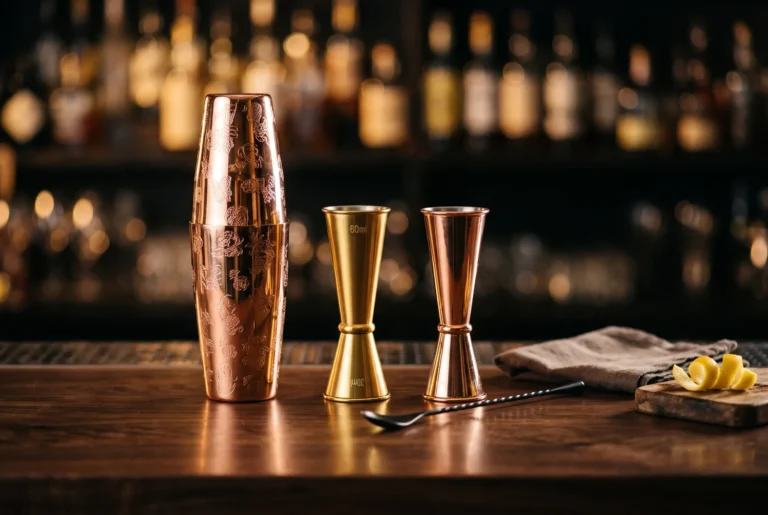
- 3 or 4 pieces: the bare necessities for discovering cocktails. The 3-piece Boston shaker set brings together the two tins, a twisted bar spoon and a double jigger. You will need to add a Hawthorne strainer.
- 8 to 12 pieces: the best-balanced format for a home bar. It also includes a strainer, a muddler and, depending on the model, ice tongs, pour spouts or a corkscrew.
- 20 to 23 pieces: for those who want everything to hand or enjoy a wide range of recipes. Additions include a fine strainer, an ice pick, straws or other serving accessories.
Ask yourself a simple question: which recipes do you actually make? If you never make a Mojito or a Caipirinha, the muddler will rarely come out. If you enjoy sours, a fine strainer will be far more useful to you than a corkscrew.
Boston or Cobbler: the choice of shaker shapes the whole kit
The shaker is the centrepiece of the kit, and many models come in two versions. The choice depends on how you work, as our Boston or Cobbler comparison explains.
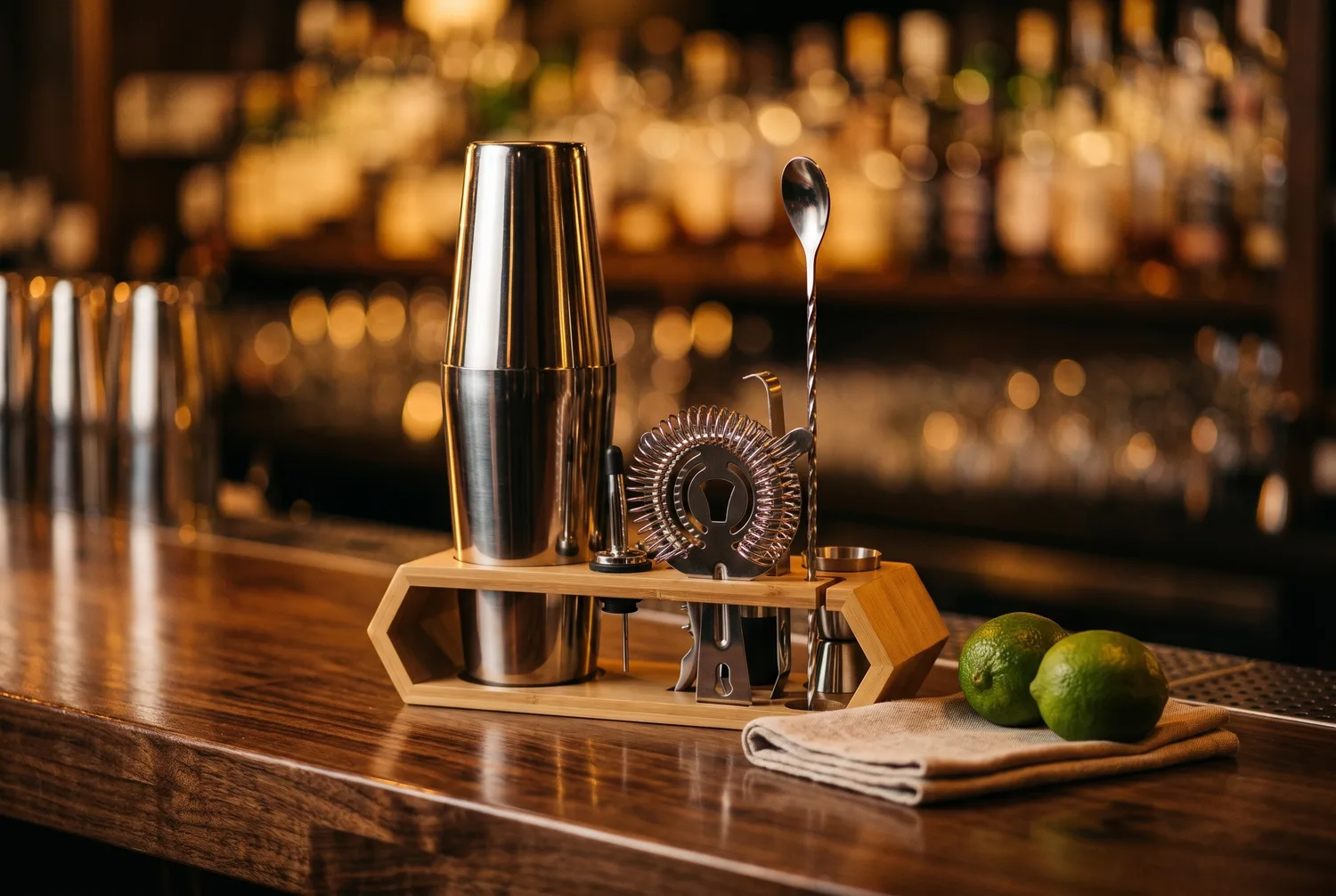
- The Boston, made of two tins, offers plenty of volume and opens with a single movement once you have the knack. It needs a separate Hawthorne strainer and a little practice. The 10-piece hexagonal cocktail kit with a 700 and 600 ml Boston is a good example of this format.
- The Cobbler, in three parts, has a strainer built into its lid. It is simpler for beginners, but the lid can jam when the metal contracts in the cold. The 8-piece black cocktail kit is built around a Cobbler 22.5 cm tall.
With a Cobbler, look at the capacity too: 550 ml suits one or two cocktails, 750 ml lets you make more in one go. Our article on which shaker capacity to choose gives more detail on these benchmarks.
304 or 201 stainless steel: what the material changes
“Stainless steel” covers several alloys that do not behave in the same way. Two grades come up often in barware, and a good product page tells you which is used:
- 304 stainless steel, often called 18/8 after its proportions of chromium and nickel, is the benchmark food-grade alloy. It resists corrosion well, including against citrus juice and moisture.
- 201 stainless steel contains less nickel, partly replaced by manganese. It costs less but resists corrosion less well, so it needs more careful drying after each wash.
201 steel is not a deal-breaker for a first set used occasionally. Our 3-piece Boston set is one example, and we say so on its product page. For a kit you expect to use often, however, 304 is the better investment: it is the material of the 8- to 22-piece kits mentioned in this guide.
The bartender’s tip
Before buying, look on the product page for three things: the steel grade, the type and capacity of the shaker, and the detailed list of pieces. If any of these is missing, compare with another model: you will have a clearer idea of what you are paying for.
The stand: storage, space and display
The stand makes more of a day-to-day difference than you might think: a tool kept in its place and in plain sight is a tool you use. Above all, it must suit the space you have available.
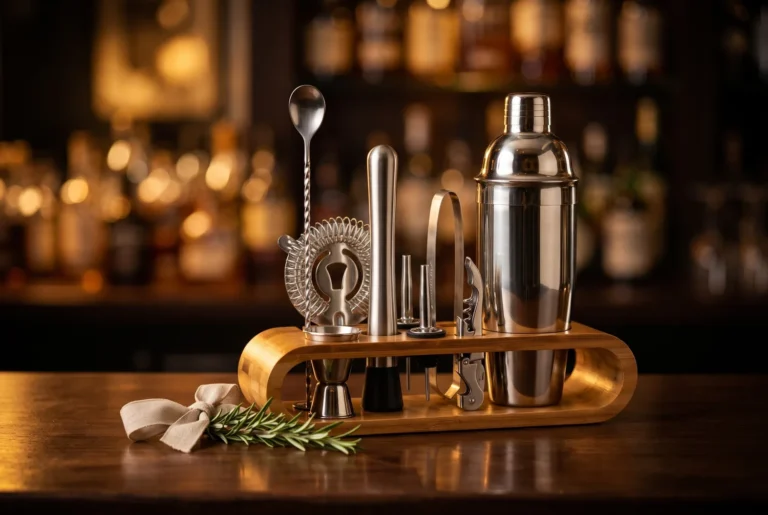
- A compact bamboo stand fits on a corner of the worktop or on a shelf. The 12-piece black cocktail kit with a Boston has an oval stand of this kind.
- A tiered stand gives each tool its own slot, which is handy for large kits such as the 20-piece bamboo kit with a 750 ml shaker.
- A bottle display stand organises the whole bar in a single unit. The 22-piece two-tier kit holds tools, bottles and glasses, but takes up more room.
- A carry case puts mobility first: the 20-piece travel bartender kit rolls up in its canvas case for an evening with friends or a weekend away.
The finish: a matter of taste, with a few precautions
Polished steel, matt black, gold, rose gold: with the same material, the finish does not change the quality of the cocktail. It affects the look of the bar and the upkeep. Polished steel is the most understated and the easiest to live with. Coloured finishes rely on a coating applied to the steel: they need gentle treatment, with no abrasive sponge, and should be washed by hand. For all our kits, we recommend washing in warm water with a mild washing-up liquid, then drying straight away with a soft cloth.
Think about the rest of your bar too. A black or gold finish goes well with a spoon or jigger in the same colour, should you add to the kit later. You can compare all the models in our cocktail kits range.
What is often missing, and how to fill the gaps
Even a large kit does not cover everything. A few pieces are worth checking, as they do not always appear on the list:
- A fine strainer, to hold back ice shards and pulp: our conical fine strainers complement kits that do not include one.
- A mixing glass, for stirred cocktails such as the Negroni or Manhattan: kits are mainly designed for the shaker. The 700 ml mixing glass with vertical ribs and its julep strainer fill this gap.
- A bar mat and tongs, found among our bar accessories, for keeping your work tidy.
A kit also makes an easy gift, since it assumes no existing equipment. For more ideas, including smaller budgets, see our page of cocktail gift ideas.
In short: which cocktail kit for which use?
- You want to try it out without clutter: a 3- or 4-piece set, adding a Hawthorne strainer if needed.
- You are equipping a proper home bar: an 8- to 12-piece kit in 304 stainless steel, with a Boston or a Cobbler according to your preference.
- You want everything together on the counter: a 20- or 22-piece kit with a tiered stand or display unit.
- You make your cocktails in different places: a travel kit in its case.
How many pieces should a cocktail kit have for a beginner?
Four tools are enough to make most classics: a shaker, a jigger, a strainer and a bar spoon. An 8- to 12-piece kit brings them all together and adds useful accessories, such as a muddler or pour spouts.
Should a beginner choose a kit with a Boston or a Cobbler?
The Cobbler is the simplest to start with, because its strainer is built in. The Boston takes a little practice and needs a separate strainer, but it offers more volume and opens with a single movement. Both can be used for the same recipes.
How can you recognise a good-quality kit?
Check that the product page states the steel grade, preferably 304, and the exact list of pieces. Look too for the tools you will use for every cocktail, rather than the total number of pieces.
Can a cocktail kit go in the dishwasher?
We recommend hand washing for all our kits: warm water, mild washing-up liquid, then immediate drying with a soft cloth. This preserves the shine of the metal and the coloured finishes, as well as the bamboo stand, which should not be left to soak.
Further reading
Please drink responsibly. Alcohol abuse is dangerous for your health.