Before a birthday, a housewarming or a wedding drinks reception, the same question always comes up: how many bottles for a cocktail party, and how much ice, how many lemons, how many glasses? This guide sets out a simple five-step method that starts from your guest list and the recipes you have chosen and ends with a precise shopping list. It relies on the real measures of each cocktail, in centilitres and millilitres, and on the bottle sizes sold in France. Three worked examples, for 10, 30 and 80 guests, show the calculation from start to finish, with an alcohol-free drink planned every time.
One point before we begin: quantities depend above all on your guests, how long the party lasts and what else is being served (a meal, wine, a buffet). The figures below are working assumptions, clearly stated, to be adjusted to your own situation; the aim is to run out of nothing without buying three times too much, not to encourage drinking. A good party also means fresh water freely available, a proper alcohol-free option and guests who get home safely.
Step 1: estimate how many cocktails you will serve
Everything starts from one number: how many drinks will you serve in total? To estimate it, first separate the guests who drink alcohol from those who do not (drivers, pregnant guests, under-18s, people who simply do not drink). Then set a number of cocktails per person according to the format of the evening. In our examples we assume a maximum of 2 cocktails per guest for a two-hour drinks reception, and 3 per guest for a four- to five-hour party with a meal or buffet. These are upper limits for the calculation, not targets: many guests will drink less, and unopened bottles keep.
- Guests who drink alcohol × cocktails per person = number of alcoholic cocktails.
- All guests × 1 to 3 drinks = number of alcohol-free drinks, on top of water.
- Add a margin of about 10% on fresh ingredients (citrus, mint), which spoil or get lost during preparation.
Step 2: keep the menu short
For a party, two or three cocktails are plenty, plus an alcohol-free one. A short menu makes shopping simpler, speeds up service and leaves fewer opened bottles. Favour long drinks, served in a highball with a mixer (ginger beer, soda water, a soft drink): they are quick to make, built in the glass or given a few seconds in the shaker, and they contain less alcohol per millilitre served than a short cocktail. The Moscow Mule, the Paloma or the Mojito are good candidates; a short drink such as the Margarita or a sparkling one such as the French 75 adds variety. To help you choose, our guide to classic cocktail measures brings together the reference recipes.
The bartender’s tip
Write down on a card, for each cocktail on the menu, the measure of every ingredient. The whole calculation in the following steps comes down to multiplying these measures by the number of drinks planned: it is simple, but this is where mistakes creep in.
Step 3: work out the bottles of spirits and mixers
Multiply the measure of each ingredient by the number of cocktails planned, then divide by the size of the bottle. In France, spirits (vodka, gin, rum, tequila, whisky) are most often sold in 70 cl bottles, wine and Champagne in 75 cl, and liqueurs in 50 or 70 cl. Always round up to the next bottle. Here is the number of whole measures a bottle holds, depending on the recipe’s measure:
- 70 cl bottle, 30 ml measure: 23 measures.
- 70 cl bottle, 45 ml measure: 15 measures.
- 70 cl bottle, 50 ml measure: 14 measures.
- 70 cl bottle, 60 ml measure: 11 measures.
- 50 cl bottle, 20 ml measure: 25 measures (orange liqueur, for example).
- 75 cl bottle of Champagne, 60 ml measure: 12 measures.
Mixers are worked out the same way: 120 ml of ginger beer per Moscow Mule, 100 to 120 ml of grapefruit soda per Paloma, 60 to 80 ml of soda water per Mojito. Keep them cold until the last moment: a warm mixer melts the ice and gives a flat drink. If your recipes come from an American book, convert the ounces first with our oz to cl conversion table.
Step 4: ice, citrus and garnishes
Ice is the most often underestimated ingredient. It is used three times over: in the shaker or mixing glass (that ice is thrown away afterwards), in the serving glass, and in the tubs or buckets that keep the bottles cold. A cautious benchmark, commonly used for receptions, is to allow about 1 kg of ice per guest for a cocktail party. Beyond ten or so guests the freezer is no longer enough: buy bags of ice on the day and keep them in a cool box. A stainless steel ice scoop saves you dipping glasses into the tub, which risks breaking them and mixing shards of glass into the ice. Our guide to ice and garnishes covers the different kinds of ice.
For citrus, allow on average 20 to 30 ml of juice per lime and 30 to 40 ml per lemon; the yield varies with the size and freshness of the fruit. In our calculations we use 25 ml per lime and 35 ml per lemon. Squeeze the juice on the day, a few hours at most before service, and keep it in the fridge in a closed bottle. Add the fruit needed for garnishes: one lime gives about 8 wedges. Mint keeps for a few hours with its stems in cold water, like a bunch of flowers.
Step 5: glasses and the bar station
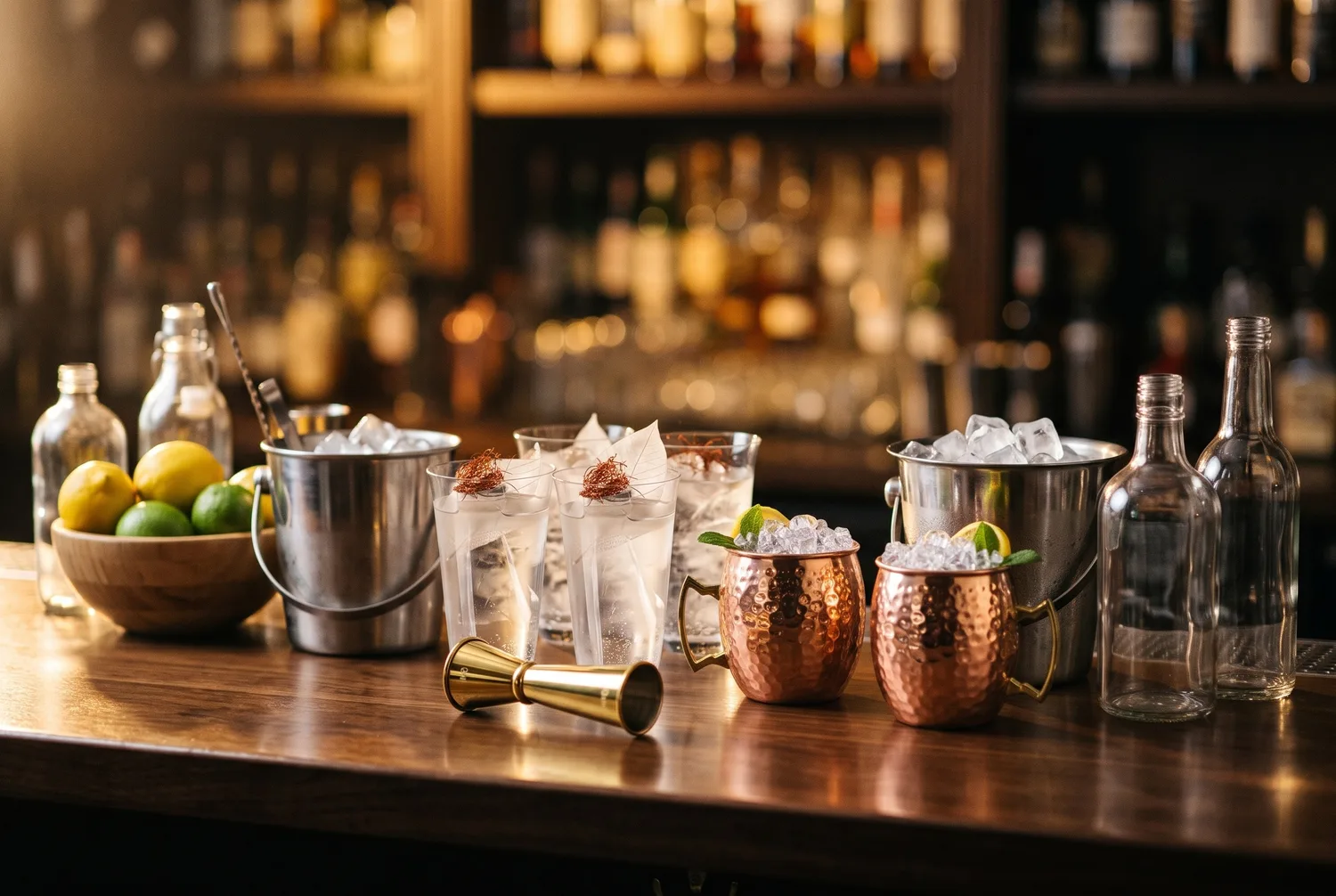
Allow at least one glass per guest for each type of glass on the menu, and more if nobody can wash up during the evening. Long drinks are served in a highball, such as our light 360 ml highball glasses; the Moscow Mule is traditionally served in a copper mug, such as our set of 4 hammered Moscow Mule mugs. For a short or sparkling cocktail, an engraved cocktail coupe works well. Our guide which glass for which cocktail helps you match each recipe with its glass.
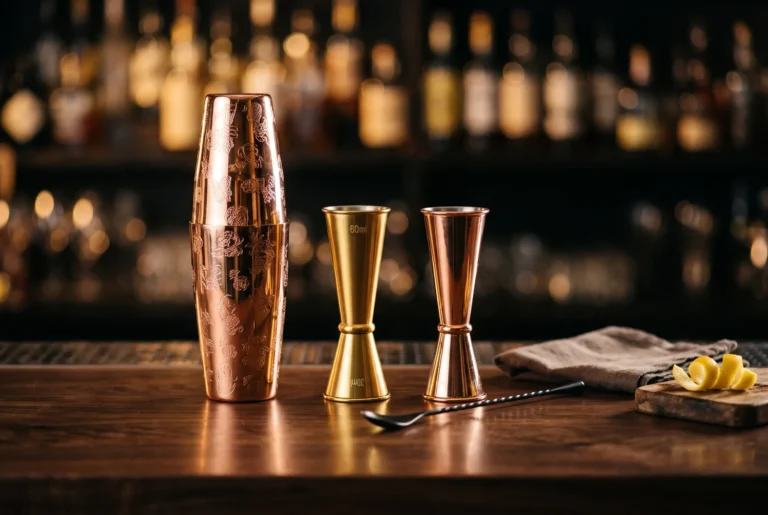
As for equipment, an efficient bar station fits on a small table: one shaker per person serving, a jigger for accurate measuring, a strainer, a bar spoon, a mat to catch drips and bottles fitted with pourers. Stainless steel pourers make pouring steadier and cleaner when you are making drink after drink, and a graduated Japanese jigger guarantees the same measure every time, which also keeps your calculation reliable. A complete cocktail kit with stand brings all these tools together; other sets are in our cocktail kits range and serving accessories in the bar accessories range. For the full list, see also the essential tools for a home bar and our guide to equipping a home bar.
Example 1: drinks and nibbles for 10 guests
Assumptions: a four-hour evening with a buffet, 8 guests who drink alcohol, at most 3 cocktails each, so 24 cocktails: 12 Moscow Mules and 12 Margaritas. For the alcohol-free option, a vodka-free “Mule” (150 ml of ginger beer and 15 ml of lime juice over ice), planned for 10 glasses. Calculation:
- Vodka: 12 × 45 ml = 540 ml, so 1 bottle of 70 cl.
- Blanco tequila: 12 × 50 ml = 600 ml, so 1 bottle of 70 cl.
- Triple sec: 12 × 20 ml = 240 ml, so 1 bottle of 50 cl.
- Ginger beer: 12 × 120 ml + 10 × 150 ml = 2.94 litres, so about 3 litres (12 bottles of 25 cl).
- Lime juice: 12 × 10 ml + 12 × 15 ml + 10 × 15 ml = 450 ml, so 18 limes, plus 5 or 6 for wedges and salt rims: about 24 limes.
- Ice: about 10 kg.
- Extras: fine salt for the Margarita rims, still and sparkling water freely available.
Example 2: a birthday party for 30 guests
Assumptions: a five-hour evening with a meal, 25 guests who drink alcohol, at most 3 cocktails each, so 75 cocktails: 25 Mojitos, 25 Palomas and 25 Moscow Mules. For the alcohol-free option, the same vodka-free “Mule”, planned for 25 glasses. Calculation:
- White rum: 25 × 50 ml = 1.25 litres, so 2 bottles of 70 cl.
- Blanco tequila: 25 × 50 ml = 1.25 litres, so 2 bottles of 70 cl.
- Vodka: 25 × 45 ml = 1.125 litres, so 2 bottles of 70 cl.
- Sugar syrup: 25 × 20 ml = 500 ml.
- Fresh mint: 25 × 10 leaves, so about 250 leaves, plus a few sprigs for garnish.
- Soda water: 25 × 70 ml = 1.75 litres, so 2 bottles of 1 litre.
- Grapefruit soda: 25 × 110 ml = 2.75 litres, so 3 litres.
- Ginger beer: 25 × 120 ml + 25 × 150 ml = 6.75 litres, so about 7 litres.
- Lime juice: 750 ml (Mojito) + 375 ml (Paloma) + 250 ml (Moscow Mule) + 375 ml (alcohol-free) = 1.75 litres, so 70 limes, plus ten or so for garnishes: about 80 limes.
- Ice: about 30 kg, including crushed ice if you serve the Mojitos that way.
This example shows how much lime weighs in the quantities: the Mojito alone calls for 30 ml of juice per glass. If squeezing 70 limes sounds like too much, swap one of the three cocktails for a recipe that uses less citrus.
Example 3: a wedding drinks reception for 80 guests
Assumptions: a two-hour drinks reception before dinner, 70 guests who drink alcohol, at most 2 cocktails each, so 140 cocktails: 70 French 75s and 70 Moscow Mules. For the alcohol-free option, the vodka-free “Mule”, planned for 40 glasses. Calculation:
- Gin: 70 × 30 ml = 2.1 litres, exactly 3 bottles of 70 cl; buy 4.
- Brut Champagne: 70 × 60 ml = 4.2 litres, so 6 bottles of 75 cl; buy 7.
- Lemon juice: 70 × 15 ml = 1.05 litres, so 30 lemons, plus a few for twists.
- Sugar syrup: 70 × 15 ml = 1.05 litres.
- Vodka: 70 × 45 ml = 3.15 litres, so 5 bottles of 70 cl.
- Ginger beer: 70 × 120 ml + 40 × 150 ml = 14.4 litres, so about 15 litres.
- Lime juice: 70 × 10 ml + 40 × 15 ml = 1.3 litres, so 52 limes, plus 14 for wedges: about 66 limes.
- Ice: about 80 kg; at this volume, look for an ice supplier who delivers in bags.
- Service: at least two people behind the bar, and the French 75 base (gin, lemon, syrup) mixed ahead in a bottle, kept cold, then shaken on ice and topped with Champagne at serving time.
The standard shopping list
Once the calculation is done, gather everything on a single list, by aisle, so nothing is forgotten on the day:
- Spirits and liqueurs: the number of bottles calculated, rounded up.
- Wine and sparkling wine: the Champagne or sparkling wine, chilled the day before.
- Mixers: ginger beer, soda water, soft drinks, tonic, bought cold or chilled the day before.
- Alcohol-free: the ingredients for the alcohol-free cocktail, juices, and plenty of still and sparkling water.
- Fresh: limes and lemons, mint, fruit for garnish, with a 10% margin.
- Store cupboard: sugar or sugar syrup, salt for rims, reusable straws.
- Ice: about 1 kg per guest, in bags, and a cool box to keep it.
- Equipment: glasses, shakers, jiggers, strainers, bar spoons, ice scoop, pourers, bar mats, tea towels.
To check the meaning of a bar term you come across in a recipe, our cocktail bar glossary explains them from A to Z.
How many cocktails can you make from a 70 cl bottle?
It depends on the recipe’s measure: 23 cocktails at 30 ml, 15 at 45 ml, 14 at 50 ml and 11 at 60 ml. Divide 700 by the measure in millilitres and keep the whole number.
How much ice do you need for a cocktail party?
A cautious benchmark is about 1 kg of ice per guest, because ice is used in the shaker, in the glass and to keep bottles cold. Beyond ten or so guests, buy bags of ice on the day.
Can cocktails be prepared in advance?
Yes, the base can: you can mix the spirits, the syrup and citrus juice squeezed on the day in a closed bottle in the fridge. Ice and sparkling mixers are always added at serving time.
What should you do with unopened bottles after the party?
Unopened spirits keep for a very long time, stored upright and away from light, which is why it is better to round up to the next bottle. Opened liqueurs keep too; vermouth and wine go in the fridge, for a few weeks at most.
Further reading
Please drink responsibly. Alcohol abuse is dangerous for your health.