A cocktail recipe often speaks a language of its own: you will come across a dry shake, a twist, a float, a Hawthorne strainer or a glass with a salted rim. This cocktail glossary brings together more than fifty bar terms, listed from A to Z, each with a short and accurate definition. Many words used behind the bar come from American bartending, and some have a French equivalent that you will find on our French pages. Whenever one of our guides covers a subject in depth, the term links to it, so you can move straight from the definition to the detailed technique. Keep this page to hand when reading a recipe, choosing a tool or working out what a bartender is doing.
How to read this glossary
Terms are grouped by letter, one block per letter, following the order of our French glossary, so a few English terms appear under the letter of their French name (the mixing glass under V, for verre à mélange); a short cross-reference sits at the other letter. The definitions describe how a word is used at the bar, not always its everyday meaning: “stirring”, for instance, refers to a precise technique in a mixing glass. Measures are given in millilitres; to convert ounces, see our oz to ml conversion chart.
The bartender’s tip
If you are just starting out, learn about ten words first: shaker, jigger, strainer, mixing glass, bar spoon, shaking, stirring, building, zest and dilution. They cover most classic recipes; the other terms will follow with practice.
Bar terms from A to Z
A
- Bitters: highly concentrated aromatic preparations made by macerating herbs, barks or spices. They are measured in dashes to lift and tie a cocktail together, as in the Old Fashioned.
- Aperitif: a drink served before a meal. At the bar, the word also describes a family of dry or lightly bitter cocktails, such as the Americano.
- Lengthen: to finish a cocktail with a mixer (soda water, soft drink, ginger beer) once it is in the glass. See also Top.
B
- Bar spoon: a long-handled spoon for stirring and layering; see the full definition under C.
- Pourer: a metal stopper with a long spout that fits on a bottle to pour in a steady stream without splashing.
- Bitters: see the definition under A.
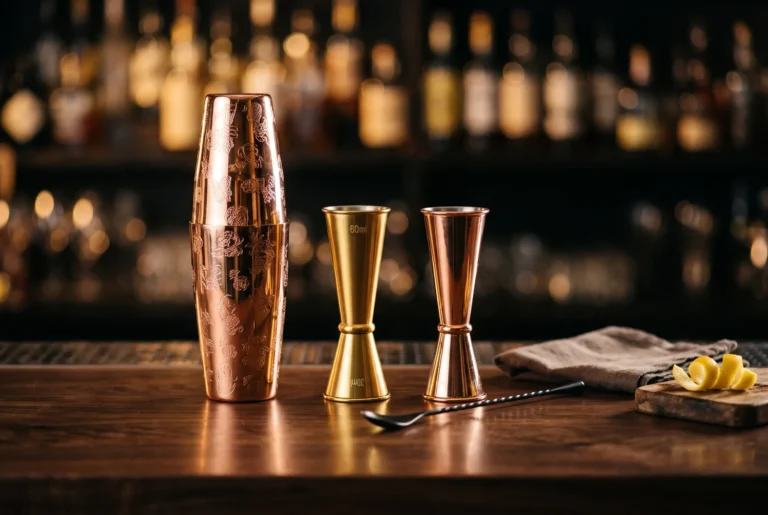
- Boston shaker: a two-piece shaker made of a large metal tin and a glass or smaller tin, which fit together by pressure. It is the professional bar shaker; our guide on how to use a Boston shaker explains the technique.
- Build: to make a cocktail directly in the serving glass, one ingredient after another, without a shaker or mixing glass. This is how a Moscow Mule is made.
C
- Cobbler shaker: a three-piece shaker made of a tin, a lid with a built-in strainer and a cap. Easy for beginners; see our guide to the cobbler shaker.
- Collins: a tall, narrow glass, and a family of long drinks combining a spirit, citrus juice, sugar and soda water.
- Coupe: a stemmed glass with a wide, shallow bowl, for cocktails served without ice, shaken or stirred. See our guide which glass for which cocktail.
- Bar spoon: a long-handled spoon, often twisted, used for stirring in a mixing glass, measuring small amounts and layering. Its capacity varies between models, around 2.5 to 5 ml.
D
- Dash: the amount that comes out of a bitters bottle fitted with a dasher top when you give it a sharp flick of the wrist. A few drops, not an exact measure.
- Dilution: the water added to a cocktail by melting ice during preparation. It softens the alcohol and balances the flavours; it is part of the recipe, as our article on how long to shake a cocktail explains.
- Double strain: straining a cocktail through both a Hawthorne strainer and a fine strainer held over the glass, to catch ice shards and pieces of fruit. See our guide to double straining.
- Dry: a dry Martini contains little vermouth; a dry vermouth is a dry white vermouth. See the Dry Martini recipe.
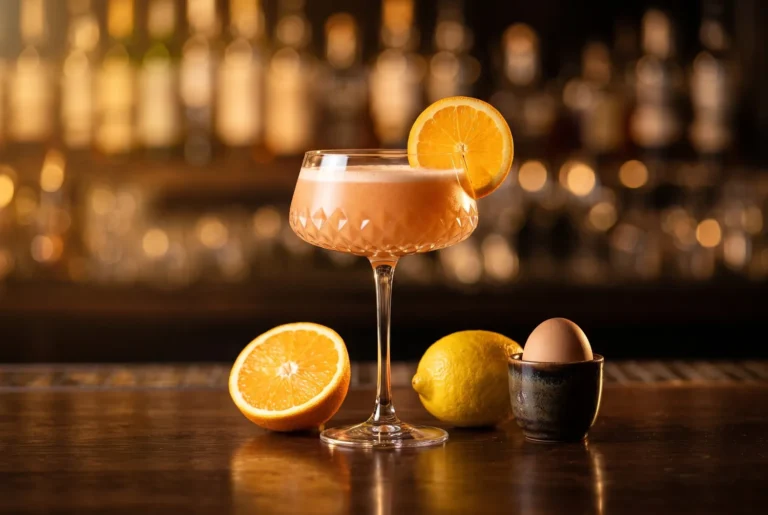
- Dry shake: shaking the ingredients once without ice, to emulsify an egg white or a substitute, then a second time with ice. It is all explained in our article on the dry shake and reverse dry shake.
E
- Emulsion: a close blend of ingredients that do not mix on their own, obtained by shaking hard. It gives the foam on a Whisky Sour made with egg white.
- Express a zest: to pinch a piece of citrus peel over the glass, skin facing the drink, to spray its essential oils across the surface.
F
- Fine strainer: a small conical strainer with a tight mesh, used for double straining.
- Fizz: a family of shaken cocktails (spirit, citrus, sugar) served in a narrow glass and topped with soda water.
- Float: to pour an ingredient gently on top of the cocktail, often over the back of a bar spoon, so that it stays as a layer on the surface.
- Frozen: a cocktail blended with ice, with a sorbet-like texture.
G
- Garnish: the finishing touch, a zest, a citrus wedge, a cherry, a mint leaf. It brings aroma as much as looks; our guide to ice and garnishes covers them all.
- Rim: to coat the edge of the glass with salt, sugar or a spice after moistening it with citrus. The salt rim of the Margarita is the best-known example.
- Crushed ice: ice broken into small pieces, which chills and dilutes quickly. It is essential to the Mint Julep and many tiki cocktails.
- Gomme syrup: sugar syrup thickened with gum arabic, which gives a rounder texture than simple syrup.
H
- Hawthorne strainer: a flat strainer edged with a spring, placed on the shaker tin to hold back the ice as you pour. Compare it with other models in our guide to cocktail strainers.
- Highball: a tall, straight glass, and a family of simple drinks combining a spirit and a mixer, served over ice.
J
- Jigger: a double-cone measure with two different capacities, often 30 and 60 ml, for measuring each ingredient. See our guide to measuring cocktails with a jigger and our comparison of Japanese and classic jiggers.
- Julep strainer: a strainer shaped like a large perforated spoon, held inside the mixing glass. The word also names a family of drinks made with mint and crushed ice.
L
- Layering: pouring several ingredients of different densities in separate layers, using a bar spoon.
- Long drink: a lengthened cocktail, served in a tall glass with plenty of ice and a mixer, as opposed to a short drink, which is smaller and more concentrated.
M
- Mixing glass: a large, thick glass with a pouring lip for stirred cocktails; see the full definition under V.
- Mocktail: an alcohol-free cocktail, made with the same techniques and the same care as a classic cocktail.
- Muddle: to gently crush fruit, herbs or sugar at the bottom of the glass or shaker with a muddler, to release juice and aromas, as in the Mojito or the Caipirinha.
- Mug: a handled vessel, in copper for Mules, in decorated ceramic for tiki cocktails.
N
- Neat: a spirit served on its own, without ice or mixer, at room temperature.
O
- Old Fashioned glass: a short, wide glass, also called a whisky tumbler or rocks glass, for cocktails served over ice.
- On the rocks: served over ice cubes.
- Oz (ounce): the unit used in American and British recipes; at the bar, 1 oz = 30 ml.
P
- Part: a proportion rather than a fixed volume. A recipe of “2 parts gin, 1 part lemon” can be made with any measure, as long as it is the same for every part.
- Fine strainer: see the definition under F.
- Muddler: a stick with a flat or toothed head, used for crushing fruit and herbs. See Muddle.
- Garnish tongs: long, fine tweezers for placing a garnish precisely without touching it with your fingers.
R
- Stir: to mix ingredients over ice in a mixing glass with a bar spoon, chilling and diluting without adding air. It is the technique for cocktails made only of spirits, explained in our guide to stirred cocktails.
- Reverse dry shake: the reverse of the dry shake, first with ice, then again without ice after straining, for a finer foam.
- Rim: see the definition under G.
- Rinse: pouring a few drops of an aromatic spirit into the glass, swirling it to coat the sides, then discarding the excess. This is how absinthe is used in the Sazerac.
- Rolling: gently pouring the cocktail and its ice from one tin to the other, to mix and chill without creating foam.
S
- Shake: to agitate the ingredients hard with ice in a shaker, to mix, chill, dilute and aerate. Our complete guide to the cocktail shaker covers the technique and the tools.
- Shaker: a closed vessel for shaking cocktails, in Boston or cobbler style. To choose one, see Boston or cobbler and which shaker size to choose.
- Simple syrup: sugar dissolved in water, most often in equal parts. It is the basic sweetener in most recipes.
- Sour: a family of cocktails combining a spirit, citrus juice and sugar, sometimes egg white, such as the Pisco Sour.
- Splash: a small amount poured without a precise measure, more than a dash.
- Straight up (up): served without ice, strained into a chilled glass, usually a coupe or Martini glass.
- Swizzle: to mix a cocktail directly in a glass filled with crushed ice by spinning a stick between your palms.
T
- Tiki: a style of exotic, rum-based cocktails with fruit juices and syrups, born in the United States in the 20th century and often served in decorated mugs, such as the Mai Tai or the Zombie.
- Tin: the metal part of a shaker. A “tin on tin” Boston pairs two tins of different sizes. If the two parts get stuck, our article on opening a stuck shaker will help.
- Top: to fill the glass to the top with a mixer, soft drink or soda water.
- Twist: a piece of citrus peel twisted and expressed over the glass; by extension, a personal variation on a classic.
V
- Mixing glass: a large, thick glass with a pouring lip, in which cocktails are stirred over ice before straining.
- Chilled glass: a glass cooled before serving, in the freezer or filled with ice and water for a few minutes, to keep the cocktail cold for longer.
W
- Whip shake: a short shake with a few pieces of crushed ice, just to mix and chill, before pouring over crushed ice.
Z
- Zest: a thin strip of citrus peel, without the bitter white pith, cut with a knife or peeler. Expressed over the glass, it perfumes the cocktail.
Terms that are often confused
A few pairs come up again and again in questions from home bartenders. Shaking or stirring: shake cocktails that contain juice, thick syrup, cream or egg, because they need vigorous mixing and aeration; stir those made only of spirits, vermouths or bitters, to keep a smooth, clear texture.
Dash, splash and part: a dash is a small amount of bitters, a few drops; a splash, a small amount of liquid poured without measuring; a part, a relative proportion to apply with the measure of your choice. Zest and twist describe the same object, but “twist” stresses the turning motion that releases the oils.
Hawthorne and julep strainers: the first sits on the shaker tin, the second fits inside the mixing glass. The fine strainer is added to either for double straining. Finally, straight up and neat both mean “without ice”, but the first describes a cocktail chilled and then strained, the second a spirit served on its own at room temperature.
The tools behind the words
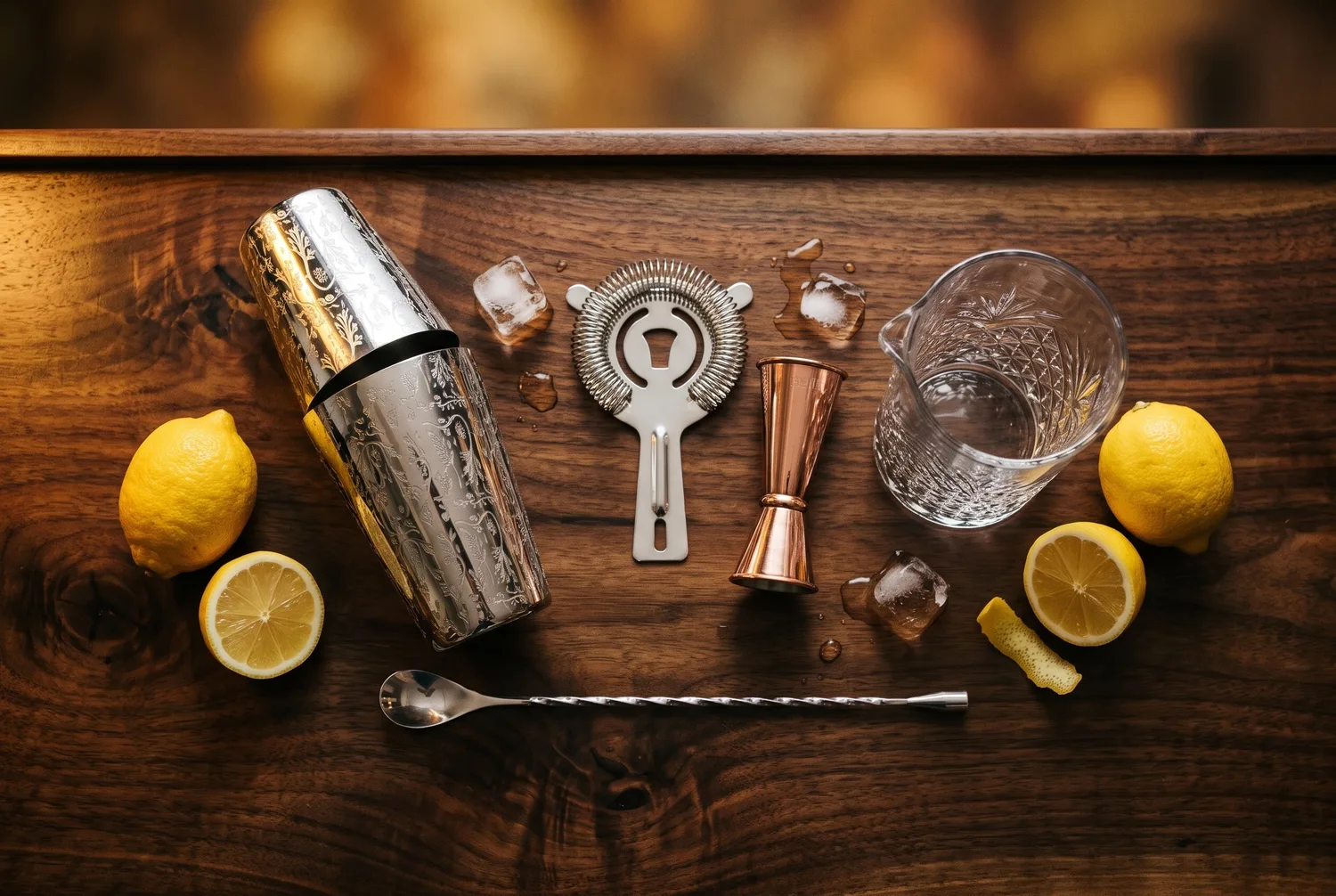
Most terms in this glossary refer to a technique, and every technique to a tool. For shaking, an engraved 500 + 800 ml Boston shaker paired with a stainless steel spring Hawthorne strainer covers the essentials. For measuring down to the dash, a graduated 30/60 ml Japanese jigger shows the half measures. For stirring, a 30 cm twisted bar spoon is used with a mixing glass and a julep strainer.
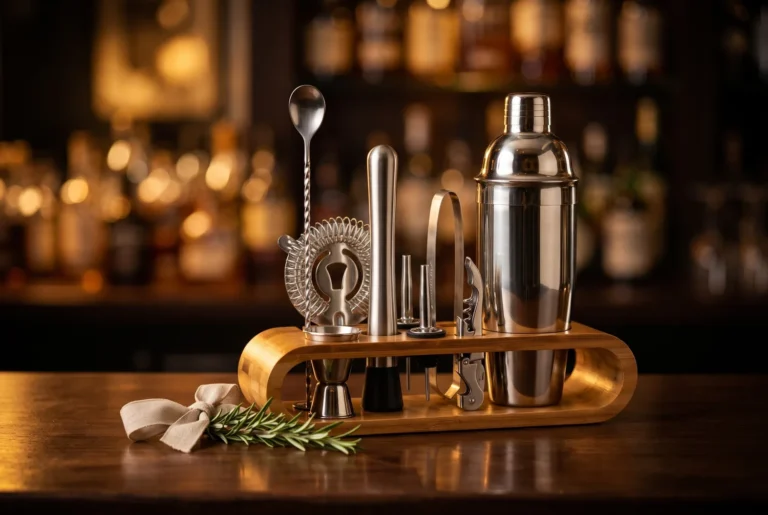
For the finishing touches, stainless steel garnish tongs place garnishes precisely, and stainless steel pourers control the flow from your bottles. If you would rather get everything at once, our cocktail kits bring together shaker, jigger, strainers and spoon; the smaller tools are in the bar accessories range. Our guide to equipping your home bar suggests a step-by-step buying order, and the list of essential home bar tools helps you choose your first pieces.
What does “dry shake” mean?
It means shaking the ingredients once without ice, to foam an egg white or a substitute, before shaking them a second time with ice.
What is the difference between “build” and “shake”?
A built cocktail is made directly in the serving glass, without a shaker. A shaken cocktail is shaken with ice in a shaker, then strained into the glass.
What does “up” mean in a cocktail recipe?
“Up” or “straight up” means the cocktail is served without ice, after being chilled in a shaker or mixing glass and strained into a chilled glass.
How much is a dash?
A dash is a few drops, the amount that comes out of a bitters bottle with a sharp flick of the wrist. It is not an exact measure.
Please drink responsibly. Alcohol abuse is dangerous for your health.