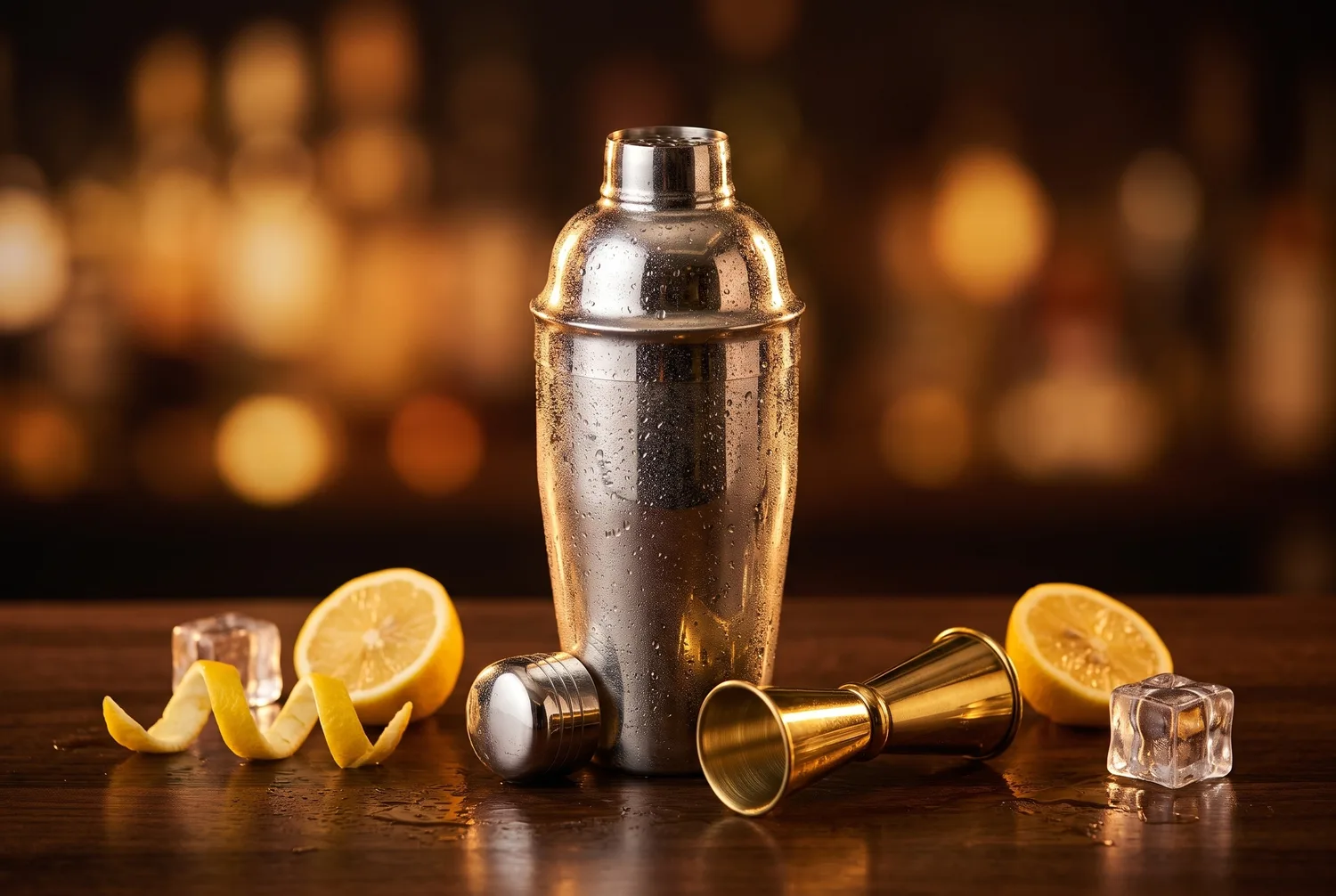
It is the shaker you find in most kitchens: a tin, a perforated lid and a small cap. The cobbler shaker looks self-explanatory, yet it has two unpleasant surprises in store for beginners: a cocktail leaking around the lid, and above all a lid that refuses to come off after a few seconds of shaking. This guide walks through its three parts, the right way to fill it, close it, shake it and pour through the built-in strainer, then the simple habits that prevent a stuck lid. It complements our complete guide to the cocktail shaker.
The three parts of a cobbler
The cobbler’s name is usually linked to the Sherry Cobbler, a drink that was hugely popular in the nineteenth century. Whatever its exact origin, its three-part construction has stayed the same, and each part has a specific job.
- The tin: the body of the shaker, which holds the ingredients and the ice. Its capacity determines how many drinks you can make at once.
- The lid with built-in strainer: it fits over the tin and ends in a neck pierced with small holes. This is what holds back the ice when you pour.
- The cap: it closes the neck while you shake. On many models it can also double as a small makeshift measure.
A 350 ml stainless steel cobbler shaker is enough for one short drink; for two drinks or a long recipe, choose a 550 ml stainless steel cobbler shaker. All our models are gathered in the cobbler shakers section.
The cap as a measure: handy, but not precise
The cobbler’s cap is often presented as a measure. It will do for a small amount of syrup or liqueur, but its capacity varies from one model to another and it is almost never marked. For a balanced cocktail, nothing beats a jigger: a graduated 30/60 ml Japanese jigger gives exact measures and can be read at a glance. If you still want to use the cap, measure its capacity once with water and a jigger, and make a note of it.
Our guide to measuring cocktails accurately explains how to hold and fill a jigger without spilling.
Filling, closing and shaking
- Pour the ingredients into the tin, starting with the least expensive: juices, syrups, then spirits.
- Add the ice last, up to about two thirds of the tin. Do not fill it to the brim: the ice needs room to move.
- Put the lid on straight and press firmly all the way round the join to seat it.
- Add the cap to the neck.
- Shake holding the shaker with both hands: one hand on the cap, the other under the tin. Allow 10 to 15 seconds, until the tin feels very cold to the touch.
Holding the cap while you shake is essential: it is the lightest part and the first to fly off if the lid loosens. Shake with a wide back-and-forth movement, over your shoulder, so that the ice hits both ends of the shaker.
Pouring through the built-in strainer
Remove the cap, and only the cap. Hold the shaker with your index finger on the lid so that it stays put, then tip it decisively over the glass: the built-in strainer holds back the ice. Its holes are, however, larger than the mesh of a fine strainer. For recipes with muddled fruit, herbs or egg white, hold a fine strainer under the neck, such as our conical fine strainers: this is the principle of double straining, which gives a perfectly smooth texture.
The bartender’s tip
Chill the serving glass while you prepare the cocktail: a few ice cubes and a little water are enough. Empty it just before you strain.
Preventing a stuck lid
A stuck lid is the cobbler’s best-known flaw. The explanation is simple: in contact with the ice, the metal cools and contracts, and the air trapped in the tin cools as well. The lid ends up pressed onto the tin, sometimes very firmly. A few precautions limit the problem:
- Do not shake for too long: beyond 15 to 20 seconds, the cold makes the lid stick harder without improving the drink.
- Open straight away: the longer the shaker stays closed, the more the lid sticks.
- Remove the cap first: air comes in through the neck, which then makes the lid easier to open.
- Seat the lid straight: put on at an angle and then forced, it jams even more.
If it still resists, do not pull with all your strength. Hold the tin in one hand and push the edge of the lid with your thumb, firmly, working gradually round the join. You can also warm the join for a few seconds with your palm, or under a trickle of lukewarm water, so that the metal relaxes. Avoid knocking it with anything hard, which may dent the lid and leave it permanently less watertight.
Care and choosing your kit
Rinse all three parts in clean water between drinks, paying particular attention to the built-in strainer, where pulp and bits of leaves lodge. Then wash by hand in hot soapy water, dry immediately and store the parts separately, with the lid off: a cobbler stored closed often ends up sticking.
If you are still torn between the two formats, our comparison Boston or cobbler: which shaker should a beginner choose? sets out the strengths of each, and our guide how to use a Boston shaker shows the other technique. To get started with everything you need, a cocktail kit on a bamboo stand with a 550 ml shaker brings together the cobbler and its accessories; other sets are available in our cocktail kits.
The cobbler also works very well for alcohol-free drinks: citrus juices, syrups and fruit purées shaken over ice become fresher and lighter. It is a good way to practise the technique.
Why does the lid of my cobbler shaker get stuck?
The cold from the ice contracts the metal and the air inside the tin, so the lid is pressed onto the body of the shaker. Shake for 10 to 15 seconds, open straight away after removing the cap, and push the edge of the lid with your thumb if it resists.
Can the cobbler’s cap be used as a measure?
It will do for a small amount, but its capacity varies between models and is generally not marked. For precise measures, use a jigger.
Do I need an extra strainer with a cobbler?
Not for most cocktails, since the strainer is built into the lid. Add a fine strainer for recipes with fresh fruit, herbs or egg white.
Which capacity should I choose?
A 350 ml model suits one short drink. A 550 ml model lets you make two drinks or a long recipe.
Further reading
Please drink responsibly. Alcohol abuse is dangerous for your health.