A good cocktail comes down to a few millilitres. The cocktail jigger, that small hourglass-shaped measure, is the tool that lets you find the same balance from one glass to the next, whether you are making a Daiquiri for yourself or a round of Margaritas for your guests. In this guide you will see why measuring matters so much, what types of jigger exist, how to read their markings, how to convert US ounces to millilitres and which moves to adopt to pour quickly and cleanly.
Why measure a cocktail precisely?
Most of the great classics rest on a simple balance between a base spirit, a sour element and a sweet element, plus the meltwater from the ice. When one of these components varies by 5 or 10 ml, the result changes noticeably: a sour becomes too tart, a stirred cocktail tastes flat or too strong. By eye, even an experienced bartender easily gets it wrong, especially with bottles of different shapes.
Measuring with a jigger brings three concrete benefits:
- Consistency: the recipe you loved once, you reproduce exactly, and you can note your adjustments to the millilitre.
- Control over the amount of alcohol: you know exactly what each glass contains, which is more responsible than free-pouring.
- Savings: spirits and liqueurs are expensive; accurate measuring avoids waste and failed cocktails nobody finishes.
Measuring is also the best way to learn. By measuring, you understand how much weight each ingredient carries in the glass, and you gradually develop your own palate to adjust a recipe to your taste or your ingredients.
The different types of jigger
All jiggers share the same principle: two cups of different capacities, joined back to back. Their silhouette, markings and grip, however, vary a great deal.
The classic jigger, or double jigger
This is the most common shape: two wide, flared cones joined at the tip. It fills easily and reads at a glance, which makes it an excellent first measure. An engraved double jigger 30/60 ml covers the vast majority of recipes: 30 ml on one side, 60 ml on the other. Its wide opening just needs a little care when pouring so that it does not overflow.
The Japanese jigger
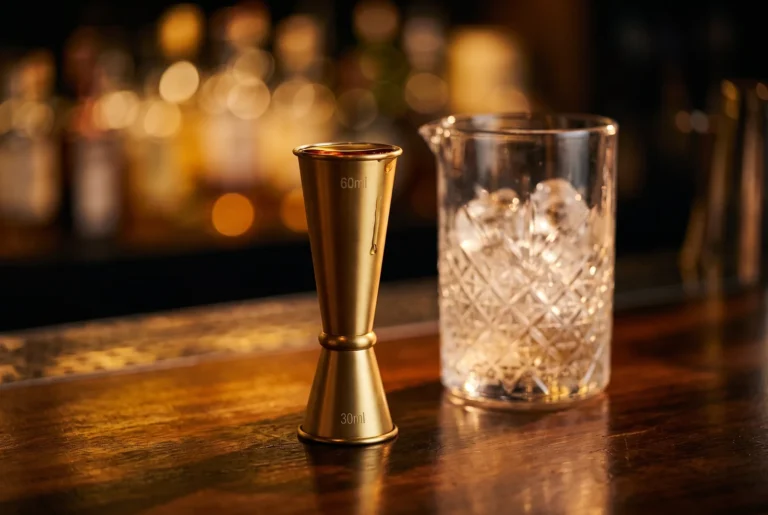
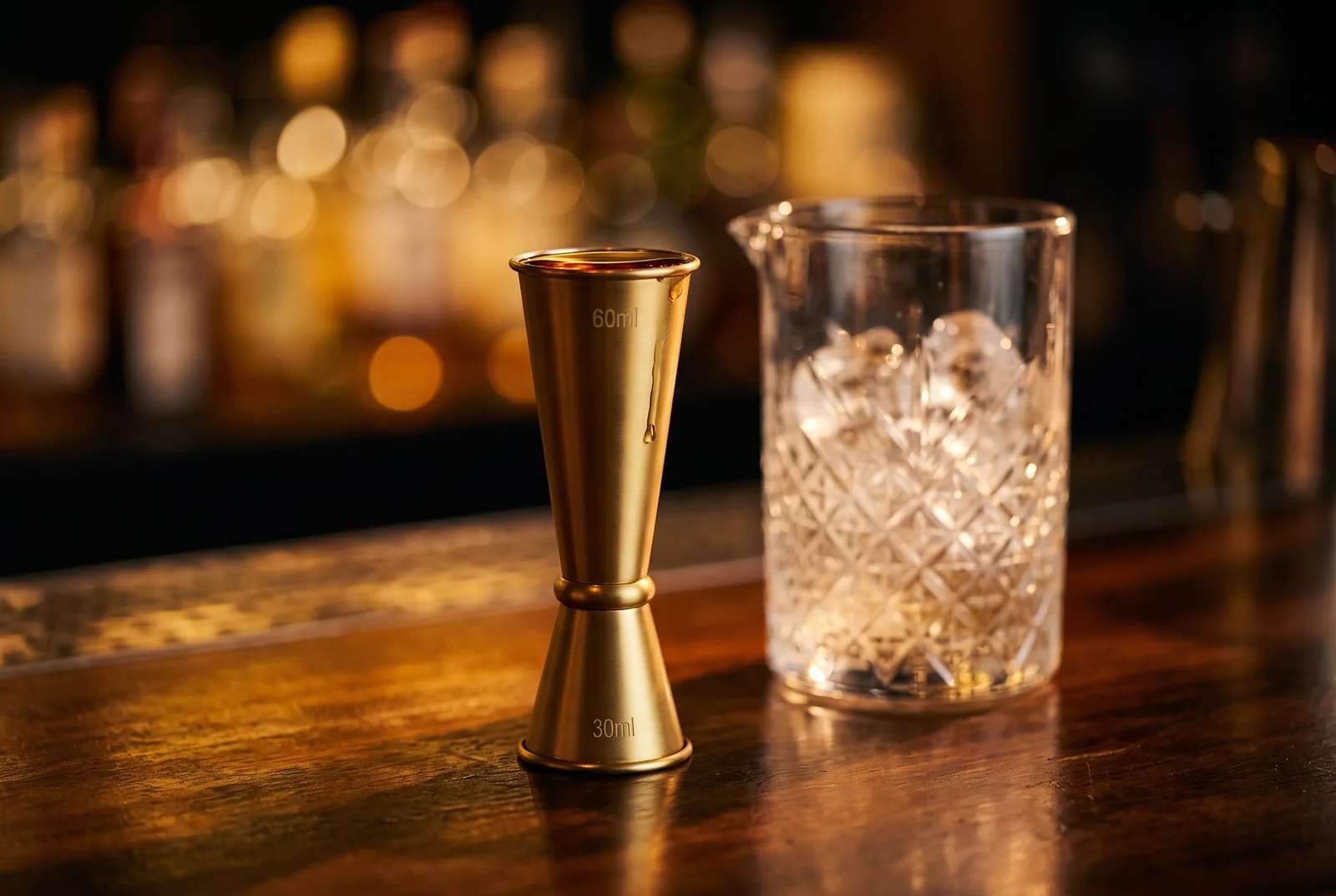
Taller and narrower, the Japanese jigger has a smaller opening that limits splashes and more vertical walls that make the inner markings easier to read. It is held like a pencil, between the index and middle fingers, which makes it very agile. The gold graduated Japanese jigger 30/60 ml and its rose gold version mark the in-between measures inside the cups. To cover even more recipes, the set of 2 Japanese jiggers 30/60 and 30/45 ml adds the 45 ml measure, common in English-language recipes.
Graduated jiggers and decorative models
Some jiggers add engraved marks to measure 10, 15 or 20 ml without changing tools. The 2-in-1 graduated jigger 30/60 ml is a good example. Other models focus on the finish, such as the stainless steel jigger with a gold ring or engraved jiggers: the capacity is the same, but they bring a personal touch to your worktop. Find every model in our jiggers section.
The choice between a Japanese and a classic jigger mainly depends on how you work: the first appeals for its precision and grip, the second for its simplicity and stability. An article in this guide compares the two in detail.
Units and conversions: ml, cl, oz
In France, recipes are written in centilitres (cl): 1 cl equals 10 ml. American books and websites use the fluid ounce (oz), which is about 29.6 ml. In practice, bartenders round 1 oz to 30 ml, which simplifies every calculation without unbalancing the recipes, since all the measures are rounded the same way.
- 1/4 oz ≈ 7.5 ml
- 1/2 oz ≈ 15 ml
- 3/4 oz ≈ 22.5 ml (often rounded to 20 or 25 ml)
- 1 oz ≈ 30 ml
- 1 1/2 oz ≈ 45 ml
- 2 oz ≈ 60 ml
Small measures have their own vocabulary too. A dash is a few drops shaken from a bottle of bitters. A bar spoon is about 5 ml, although its capacity varies from one model to another. A future article in this guide will give a complete conversion table so you can read an American recipe with confidence.
How to use a jigger: the right moves
Measuring well is first a matter of technique. With a little practice, the jigger becomes as fast as pouring by eye, while staying precise.
- Hold the jigger over the shaker or mixing glass, never beside it: if a drop overflows, it falls into the drink and not onto the counter.
- Keep it straight, pinched between thumb and index finger at the waist, or between the index and middle fingers for a Japanese model.
- Fill it to the brim: a jigger is read full, with a slight meniscus on the surface. Stopping half a centimetre below the rim throws off the measure.
- Pour with a decisive movement, tipping your wrist towards the inside of the vessel, then let the last drops run out.
- Start with the cheapest ingredients (juices, syrups) and finish with the spirits: if you make a mistake, you only lose a few cents.
The bartender’s tip
Before your first cocktail, practise with water: fill the jigger to the brim, pour it into a graduated measuring jug and check the amount. You will then know exactly where the marks of your model sit and which movement lets you pour without losing a drop.
An article in this guide will look in detail at how to hold the jigger and the rhythm to adopt to pour without spilling, even when several cocktails follow one another.
The balance of a cocktail: the logic of proportions
The jigger is not just a measuring tool; it helps you understand how recipes are built. Many sours follow a ratio close to 2-1-1: two parts base spirit, one part sour, one part sweet. The Daiquiri and the Whisky Sour come close to it, adjusted for the acidity of the citrus and the strength of the spirit. Stirred cocktails, such as the equal-parts Negroni, rest instead on a balance between alcohol, bitterness and sweetness.
Once you have these reference points, the jigger lets you change a recipe methodically: take out 5 ml of syrup if the cocktail is too sweet, add 5 ml of juice if you want it sharper, and write down each version. Balance will be the subject of a dedicated article in this guide, as will the measures of the great classics gathered in one table.
And for alcohol-free cocktails?
The jigger is just as useful for alcohol-free cocktails. Juices, syrups, infusions and sparkling waters need the same balance between sour and sweet, and a drink that is too sweet is hard to rescue. Measure your alcohol-free creations with the same rigour: you will get drinks as clean and repeatable as the classics.
Choosing and looking after your jigger
For a first purchase, go for a 30/60 ml model in stainless steel: it covers most recipes and stands up to repeated washing. Check for inner markings if you often make recipes with 15 or 20 ml measures. If you make a lot of English-language recipes, a second 30/45 ml jigger will save you time.
As for care, rinse the jigger between ingredients, especially after a sticky syrup or liqueur, so as not to throw off the next measure. Then wash it in hot soapy water and dry it at once with a soft cloth, particularly gold, rose gold or engraved finishes, which keep their shine that way. Keep it within reach, next to your shaker: our complete guide to the cocktail shaker and our selection of the essential tools for a home bar will help you complete your station.
Frequently asked questions
Which jigger capacity should I choose to start with?
A 30/60 ml jigger is the most versatile: it measures 30 ml and 60 ml directly, and graduated models let you read in-between measures such as 15 or 20 ml.
How many millilitres are there in an ounce (oz)?
A US fluid ounce is about 29.6 ml. At the bar it is rounded to 30 ml, which keeps the proportions of the recipes intact.
Can you measure a cocktail without a jigger?
Yes, with a tablespoon (about 15 ml) or a kitchen measuring jug, but it is slower and less precise. The jigger remains the most reliable tool to reproduce a recipe.
Japanese or classic jigger: which is more precise?
For the same capacity, both measure the same amount. The narrower Japanese jigger makes the inner markings easier to read and limits overflowing, which makes it more comfortable for in-between measures.
The articles in this guide
No articles yet.
Please drink responsibly. Alcohol abuse is dangerous for your health.