The jigger is the simplest tool on the bar: two cups, two measures. Yet it is often the one we spill with most: a cup filled too high that runs over your fingers, a hesitant pour that dribbles down the side, a few drops missing when you come to taste. Learning to use a jigger properly comes down to a handful of precise moves: how you hold it, how you fill it to the brim, the motion you use to empty it and the rhythm to keep when the ingredients follow one another. This guide goes through them one by one, so that every measure lands whole in the shaker or mixing glass and your work surface stays dry. It complements our complete guide to measuring cocktails with a jigger.
Why the jigger overflows
Before correcting the technique, it helps to understand where the losses come from. They almost always have one of these four causes:
- A hand that moves while filling: the jigger is held in mid-air, away from the shaker, and the slightest wobble sends liquid over the rim.
- Filling too slowly at the end: you slow down, the bottle drips, you add a little more, and the meniscus finally breaks.
- Too timid a pour: when you tip the jigger gently, the liquid follows the outer wall instead of falling into the tin.
- The wrong position: measuring beside the shaker, over the work surface, means carrying a full cup several centimetres.
Each of these causes has its answer, and they all rest on the same idea: a short, decisive movement, always above the vessel.
Holding the jigger properly
The grip depends a little on the shape of your jigger, but the principle is the same: hold the jigger by its waist, the narrow part joining the two cups, never by the rim of a cup. That keeps your fingers away from the liquid and lets you flip it without changing your grip.
The “pencil” grip
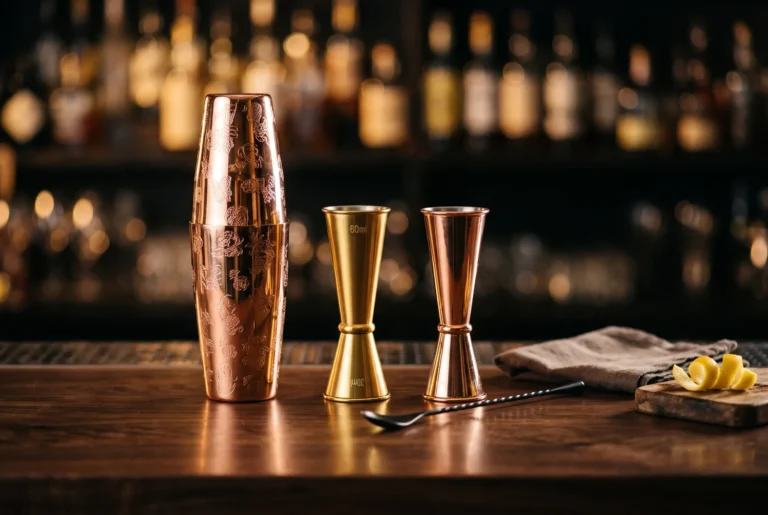
This is the most common grip behind the bar, especially with a tall Japanese jigger. Place the waist of the jigger between your index and middle fingers, like a pencil held flat, with the cup to be filled facing up. Your thumb stays free and steadies the whole thing if needed. To empty, simply turn your wrist: the jigger tips over the shaker without your fingers moving. A slender model such as the rose gold graduated 30/60 ml Japanese jigger lends itself particularly well to this grip.
The “pinch” grip
With a classic jigger, wide and short, many people prefer to pinch the waist between thumb and index finger, other fingers tucked in. This grip is intuitive and very stable, ideal when you are starting out. It simply means turning your whole forearm to empty it, a slightly wider movement. A jigger with a grip marker, such as the stainless steel 30/60 ml jigger with a gold ring, helps you place your fingers in the same spot every time.
If you are still unsure which shape suits you, our comparison of the Japanese and classic jigger sets out the strengths of each.
Filling to the brim without overflowing
A jigger measures accurately when it is filled to the brim, with a slight meniscus: the surface of the liquid forms a very gently domed curve, without running over. To get there cleanly:
- Hold the jigger just above the shaker tin or mixing glass, a few centimetres over the opening. That way, a drop that spills falls into the drink rather than onto the work surface.
- Keep the jigger still and perfectly upright: the bottle comes to it, not the other way round.
- Pour in a steady stream, without jerks, bringing the neck close to the cup. A pour spout, if you use one, makes the flow more predictable.
- Slow down as you approach the rim, then lift the bottle sharply as soon as the meniscus forms: the clean movement cuts the stream without an extra drop.
For an intermediate measure, 15 or 20 ml for instance, aim for the line engraved inside the cup, looking at the jigger at eye level rather than from above: the viewing angle easily distorts your reading. If your recipe is in ounces, our oz to ml conversion table gives you the exact measure to aim for.
The bartender’s tip
Practise with water tinted by a few drops of syrup: fill the jigger to the brim ten times in a row over a glass, then pour the lot into a measuring jug. You will see straight away whether you are consistent, and you will learn the movement without wasting ingredients.
Pouring with a decisive movement
The pour is the moment you lose the most liquid, and it is often out of excess caution. A jigger tipped slowly lets the liquid slide along its rim, then down the outer wall, and a few drops end up beside the tin. The right movement is the opposite: quick, a sharp turn of the wrist, almost vertical, above the opening of the shaker. The liquid drops in one go, straight into the tin.
Then hold for half a second, jigger upside down, to let the last drop fall before turning it back. For thick ingredients such as syrups, diluted honey or creamy liqueurs, this pause is a little longer: some of it clings to the walls. Some bartenders then rinse the cup with the next ingredient, pouring it into the same vessel, so nothing is lost.
Finding the right rhythm
When a recipe has three or four ingredients, order and rhythm prevent mistakes as much as spills. A few simple habits:
- Prepare everything before you start: bottles open, citrus squeezed, syrups within reach, on an anti-slip bar mat that catches drips and stops the glass from sliding.
- Pour from cheapest to most expensive: juices and syrups first, spirits after. If you make a mistake, you only start again with inexpensive ingredients.
- Add the ice last, just before shaking or stirring: dilution only starts at that point.
- Keep the same jigger for the whole recipe and flip it between measures rather than switching: fewer movements, fewer risks.
With two jiggers of different sizes, one 30/60 ml and the other 30/45 ml, you also avoid measuring 45 ml in two goes: that is the whole point of the set of 2 Japanese jiggers, 30/60 and 30/45 ml. Fewer fills means fewer chances to spill.
Looking after your jigger
A clean, dry jigger is easier to handle: fingers slipping on a wall sticky with syrup are the surest way to drop it. Rinse it in clean water between recipes, especially after a sweet or creamy ingredient, and wipe it before picking it up again. At the end of the session, wash it in hot soapy water and dry it straight away, particularly gold or engraved finishes such as the engraved 30/60 ml jigger with a petal pattern, to keep their shine. All our models are in the jiggers range.
These movements apply to every drink: an alcohol-free cocktail needs the same balance between acidity and sweetness, and therefore the same precision in its measures.
Frequently asked questions
Should the jigger be filled right to the rim?
Yes, for the full measure: the jigger is calibrated to the brim, with a slight meniscus. For a smaller measure, aim for the line engraved inside the cup.
How should I hold a jigger so I don’t spill?
By its waist, never by the rim of a cup: between index and middle fingers for the pencil grip, or pinched between thumb and index finger. Keep it still above the shaker while you fill it.
Why does the liquid run down the side when I pour?
Because the jigger is tipped too slowly: the liquid follows the outer wall. Flip it with a decisive movement, almost vertical, above the opening.
In what order should I pour the ingredients?
From cheapest to most expensive: juices and syrups first, spirits after, then the ice just before shaking or stirring.
Further reading
Please drink responsibly. Alcohol abuse is dangerous for your health.