American and many British cocktail recipes almost always give their measures in ounces, shortened to “oz”. In France, and across most of Europe, bartenders think in centilitres and millilitres. To convert oz to ml, the bar rule fits on one line: 1 oz = 30 ml = 3 cl. This reference guide brings together every conversion you need behind a bar: ounces, millilitres and centilitres, but also the bar spoon, dash, splash, drop and “part”. It explains why rounding to 30 ml is perfectly sound, then shows step by step how to read an American recipe and reproduce it with your jigger. Keep it to hand: each unit is set out in a short list, easy to check while you mix.
The bar rule: 1 oz = 30 ml
The American fluid ounce, the US fluid ounce, is exactly 29.57 ml. The British imperial fluid ounce is 28.41 ml. In bar practice, both are rounded to 30 ml, or 3 cl. This rounding is universal among bartenders who work in metric, and it is the one used by metric graduated jiggers: the most common size, 30/60 ml, matches 1 oz and 2 oz exactly once rounded.
The gap between 29.57 ml and 30 ml is about 1.5%. In a cocktail it is imperceptible, all the more so because the rounding applies to every ingredient: the proportions of the recipe stay the same. And it is the balance between spirit, acidity and sugar that makes a cocktail taste right, far more than its total volume. Our guide to measuring cocktails with a jigger looks at this idea of proportions in detail.
The bartender’s tip
To convert any measure given in ounces, simply multiply by 30 to get millilitres, or by 3 to get centilitres. The other way round, divide millilitres by 30.
The ounce conversion chart
Here are the measures found in the vast majority of recipes, from smallest to largest. The rounded bar value comes first, with the exact value of the US ounce in brackets.
Small measures
- 1/8 oz = 3.75 ml = 0.375 cl, usually rounded to about 4 ml (exact: 3.7 ml)
- 1/4 oz = 7.5 ml = 0.75 cl (exact: 7.4 ml)
- 1/3 oz = 10 ml = 1 cl (exact: 9.9 ml)
- 1/2 oz = 15 ml = 1.5 cl (exact: 14.8 ml)
- 2/3 oz = 20 ml = 2 cl (exact: 19.7 ml)
- 3/4 oz = 22.5 ml = 2.25 cl (exact: 22.2 ml)
Everyday measures
- 1 oz = 30 ml = 3 cl (exact: 29.6 ml)
- 1 1/4 oz = 37.5 ml = 3.75 cl (exact: 37 ml)
- 1 1/2 oz = 45 ml = 4.5 cl (exact: 44.4 ml)
- 1 3/4 oz = 52.5 ml = 5.25 cl (exact: 51.8 ml)
- 2 oz = 60 ml = 6 cl (exact: 59.1 ml)
Large measures
- 2 1/2 oz = 75 ml = 7.5 cl (exact: 73.9 ml)
- 3 oz = 90 ml = 9 cl (exact: 88.7 ml)
- 4 oz = 120 ml = 12 cl (exact: 118.3 ml)
- 6 oz = 180 ml = 18 cl (exact: 177.4 ml)
- 8 oz, or 1 US cup = 240 ml = 24 cl (exact: 236.6 ml)
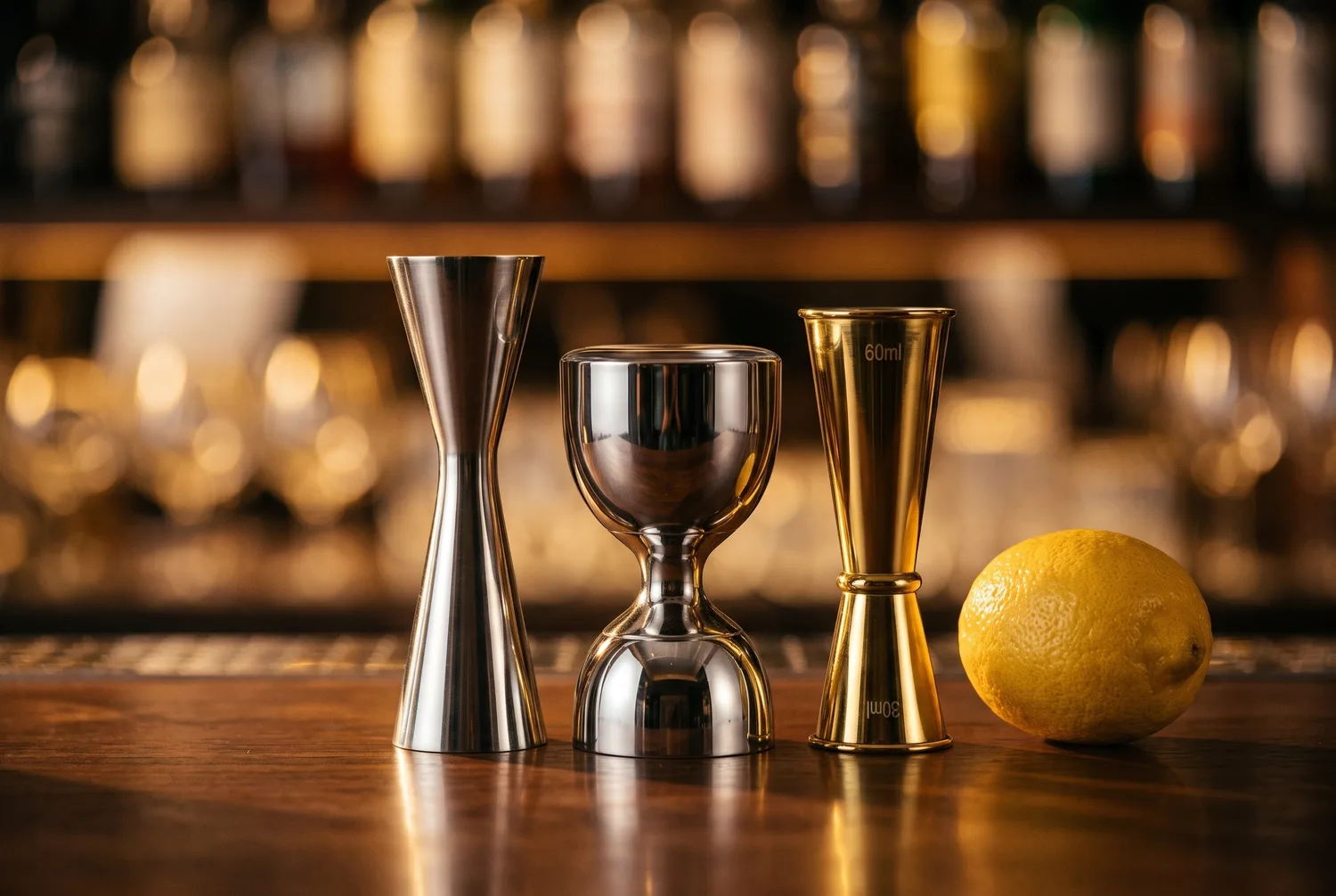
The 3/4 oz measure, 22.5 ml, crops up constantly in American recipes, especially for citrus juice and syrups. A graduated Japanese jigger lets you measure it precisely: on a 30/60 ml model, the intermediate 22.5 ml mark, or a line three-quarters of the way up the small cup, gives you this measure. The set of 2 Japanese jiggers, 30/60 and 30/45 ml covers most of the chart without any maths: 30, 45 and 60 ml directly, and the rest thanks to the inner graduations.
Bar spoon, dash and other small units
Below a quarter ounce, recipes use smaller units, some of which are not standardised. Here is their usual value and how to measure them.
The bar spoon
- 1 bar spoon (barspoon) = about 5 ml = 0.5 cl
- The actual capacity varies from model to model, from roughly 2.5 to 5 ml: measure yours once with a graduated jigger.
- Used for: small amounts of syrup and liqueur, absinthe to rinse a glass, sweet bitter liqueurs.
A 30 cm twisted bar spoon is first and foremost for stirring, but its bowl also measures these small amounts. To find out its capacity, fill it to the brim with water several times over a graduated jigger and count.
Teaspoon and tablespoon
- 1 teaspoon (tsp) = 5 ml = 0.5 cl
- 1 tablespoon (tbsp) = 15 ml = 1.5 cl, or 1/2 oz
- In an English-language recipe, “tsp” and “tbsp” mean these kitchen measures, not the bar spoon.
The dash
- 1 dash = the amount that comes out of a bitters bottle fitted with a dasher top, with one sharp flick of the wrist
- Usual value: under 1 ml; it depends on the dasher and how full the bottle is.
- Used for: aromatic bitters and a few highly perfumed liqueurs.
The French “trait”
- 1 trait = the French equivalent of a dash
- In a French recipe, “un trait de bitter” means a dash of bitters; “un trait de citron” or “un trait d’eau gazeuse” simply means a small amount, adjusted to taste.
The splash
- 1 splash = a small amount poured without measuring, more generous than a dash
- A splash has no standard value: read it as a small pour, in the region of 10 ml. Taste and adjust.
- Used for: soda water, juice, cream, to lengthen or round off a cocktail.
The drop
- 1 drop = a fraction of a millilitre, added with a pipette or dropper
- Used for: saline solution, orange flower water, very concentrated bitters.
The “part” and other recipe terms
Some recipes give no unit of volume at all. They speak in parts, or use terms that describe an amount or a technique. Here is how to read them.
The part
- 1 part = a unit of proportion, not a fixed volume
- Choose the size of the part according to the volume you want: with 1 part = 30 ml, a recipe of “2 parts gin, 1 part lemon, 1 part syrup” gives 60 ml, 30 ml and 30 ml.
- Equal-parts cocktails, such as the Last Word or the Negroni, are measured this way: use the same measure for every ingredient.
Topping and finishing terms
- Top or top up = fill the glass to the top, usually with a sparkling mixer
- Float = pour a small amount gently onto the surface so that it sits as a layer, often over the back of a bar spoon
- Rinse = pour a few drops into the glass, swirl to coat the inside, then discard the excess
Old measures
- Pony = 1 oz, or 30 ml, in older recipes
- Jigger, used as a unit = 1 1/2 oz, or 45 ml, in many American recipes
- Shot = a single serving of spirit; its size varies from country to country, around 1 1/2 oz in the United States. In the United Kingdom, the law requires 25 ml or 35 ml for spirits served on their own, and some British recipes use these measures.
Reading an American recipe step by step
Take a Daiquiri recipe as you would read it in an American book: 2 oz white rum, 1 oz fresh lime juice, 3/4 oz simple syrup. Shake with ice, strain into a chilled coupe. Here is how to convert it and make it.
- Convert each measure with the bar rule: 2 oz = 60 ml white rum, 1 oz = 30 ml lime juice, 3/4 oz = 22.5 ml syrup.
- Check the ingredients: simple syrup is a sugar syrup made with equal parts sugar and water; rich syrup uses two parts sugar to one part water and is sweeter. Fresh lime juice means lime juice squeezed just before use.
- Check the techniques: shake = shake in a shaker; stir = stir in a mixing glass; build = make directly in the glass; strain = strain; double strain = strain through a fine strainer as well.
- Check the serve: up or straight up = served without ice, in a chilled stemmed glass; on the rocks = over ice; neat = a spirit served on its own, without ice.
- Measure with the jigger, starting with the cheapest ingredients: if you make a mistake, you do not waste the spirit.
The result is our Daiquiri recipe, with its measures in metric. The same method works for every classic. If a recipe calls for a dry shake, see our guide to the dry shake and reverse dry shake; for a stirred cocktail, our guide to stirred cocktails; for a double strain, our article on double straining.
Which jigger for measuring in millilitres?
A 30/60 ml double jigger measures 1 oz and 2 oz directly, once rounded. For other measures, choose a model with inner graduations: the lines show 15, 22.5 or 45 ml depending on the model. The graduated 2-in-1 30/60 ml jigger is a good place to start; Japanese jiggers, taller and narrower, make the graduations easier to read precisely, like the gold graduated 30/60 ml Japanese jigger. Every model is in our jiggers range.
- Fill to the brim: a full measure is read level with the rim, without a dome spilling over.
- Read at eye level for inner graduations.
- Pour in one clean movement into the shaker or mixing glass, without dripping the jigger over the counter.
How many ml in 1 oz?
At the bar, 1 oz = 30 ml = 3 cl. The exact value of the US fluid ounce is 29.57 ml: the difference is imperceptible in a cocktail.
How do you convert 3/4 oz to ml?
3/4 oz = 22.5 ml, or 2.25 cl. A graduated jigger lets you measure it precisely.
How many ml in a bar spoon?
About 5 ml, but capacity varies between models, often from 2.5 to 5 ml. Measure yours once with a graduated jigger.
What does “1 part” mean in a cocktail recipe?
A part is a proportion, not a fixed volume. Choose a measure, for example 30 ml, and use it for every part of the recipe.
Please drink responsibly. Alcohol abuse is dangerous for your health.