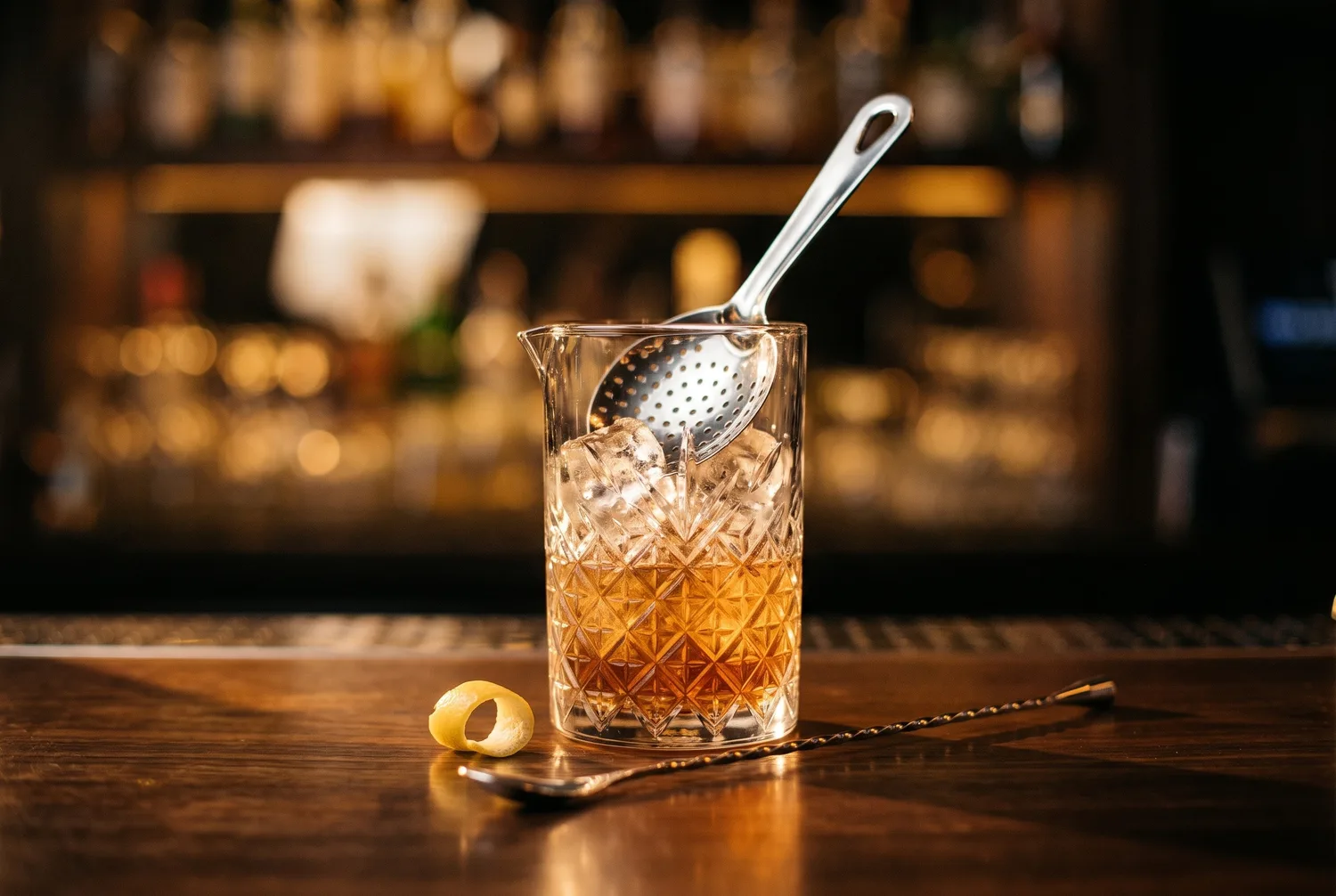
With its round, perforated bowl and short handle, the julep strainer looks rather like a large slotted spoon. Yet it is one of the oldest tools behind the cocktail bar, and the natural partner of the mixing glass. This guide traces its origins, explains why it suits stirred cocktails so well, describes how to hold it and strain with it, then gives you the points to check when choosing one and how to look after it.
To see where the julep fits among the other designs, our guide to cocktail strainers: Hawthorne, julep and fine strainer introduces the three families and what each is for. Here, we focus on the julep.
A strainer born with the Mint Julep
The julep strainer takes its name from the Mint Julep, a mix of bourbon, sugar and mint served over crushed ice that was hugely popular in the United States in the 19th century. At the time, drinking straws were not yet in common use. So the strainer was placed directly on the glass, or in it, to hold back the ice and mint leaves while people drank. The drinker kept the drink cold without swallowing ice or mint.
Once straws became widespread, the julep left the customer’s glass and stayed behind the bar. Bartenders kept using it to strain cocktails prepared in a glass or a tin. The Hawthorne strainer, with its spring, only appeared at the end of the 19th century: the julep is therefore the older of the two, and it has kept its place despite the arrival of its younger sibling.
What is a julep strainer used for today?
Today, the julep is first and foremost the strainer for the mixing glass. Its round bowl slips into the mouth of the glass and rests against the ice, which makes it very stable. The Hawthorne, designed for the opening of a shaker tin, tends to slide around on the thick rim of a mixing glass.
It is particularly suited to stirred cocktails, made without fruit juice or egg white: the Martini, Manhattan, Negroni, a modern-style Old Fashioned or the Hanky Panky. These drinks are stirred with large ice cubes that stay whole; there is no pulp or ice shards to catch, and the holes of the julep are more than enough. To go over the whole method, from the ice to serving, read our article on how to use a mixing glass.
- What the julep holds back: ice cubes and larger pieces, such as a twist or a peel left in the glass.
- What it lets through: fine ice shards, pulp and small bits of fruit or herbs.
- Where to use it: in a mixing glass, or in the small tin of a Boston when you have stirred in it.
- Where to avoid it: for a citrus cocktail that is shaken and served straight up, the Hawthorne and a fine strainer do a far better job.
How to hold and use a julep strainer
The technique takes just a few attempts to learn. Once the cocktail is stirred and the twisted bar spoon removed, proceed as follows:
- Slide the strainer into the mixing glass, with the bowl resting on the ice and its edge against the side, on the spout side.
- Take hold of the glass near the top, between your thumb and your last fingers, leaving your index finger free.
- Place your index finger on the handle, just above the bowl, and press lightly to hold the strainer against the ice.
- Tilt the glass over the serving glass and pour in one steady movement, without jerking, down to the last drop.
- Set the glass upright, remove the strainer and lay it flat on a bar mat or a cloth.
Bartenders usually place the hollow of the bowl facing the ice; some prefer it the other way round. The direction matters less than the pressure: as long as your index finger keeps the strainer in place, the ice will not get through. The mixing glass is held in the same way as when stirring, as explained in our article on how to stir a cocktail with a bar spoon.
The bartender’s tip
If you have not yet got the hang of it, practise with water and ice cubes in the mixing glass. After a few pours, you will know how much pressure to apply with your index finger so that the strainer stays put, even when the glass is almost horizontal.
Common mistakes
- Holding the strainer by the end of the handle: it tips over as soon as you tilt the glass and lets the ice slip through. Press close to the bowl.
- Pouring too slowly: the stream hesitates, runs down the side of the glass and drips beside it. A confident pour gives a clean stream.
- Straining a citrus cocktail with the julep alone: pulp and ice shards pass through the holes. For these recipes, hold a fine-mesh strainer over the glass as well, or use the Hawthorne instead.
- Leaving too little ice in the glass: the strainer has nothing to rest on and sinks. Fill the mixing glass at least two-thirds full.
Pairing a main strainer with a fine strainer has a name: double straining. It is mostly useful after shaking, and our guide to double straining explains the technique in detail.
Julep or Hawthorne: which should you choose?
The two strainers do not do quite the same job. Thanks to its spring, the Hawthorne holds back more small debris and lets you control the flow: it is made for the shaker, as explained in our guide on how to use a Hawthorne strainer. The simpler julep is made for the mixing glass, where it sits better and is quicker to handle.
If you rarely shake and often stir, start with the julep; if you mainly make sours, start with the Hawthorne. In time, most home bartenders keep both, as they are inexpensive and together they cover every cocktail. All the models are gathered in our cocktail strainers section.
Choosing and caring for your julep strainer
When buying one, check three things. First, the diameter of the bowl: it should be slightly smaller than the mouth of your mixing glass so that it slides in without forcing, while still covering almost the whole surface. Second, the thickness: rigid stainless steel will not bend under your finger. Finally, the handle: long enough for a good grip, without sticking out of the glass too far.
A stainless steel julep strainer goes naturally with a 700 ml cut-crystal mixing glass, whose opening leaves room for the bowl. To compare the glasses themselves, see our guide to choosing a mixing glass.
Care is simple, because the julep has no spring for debris to get caught in:
- Rinse it in clean water straight after use, before the sugar dries in the holes.
- If a hole gets blocked, use a small brush or a toothpick under running water.
- Dry it with a clean cloth to avoid limescale marks on the stainless steel.
- Store it flat or hanging, so the bowl does not get bent out of shape.
Why is it called a julep strainer?
It is named after the Mint Julep: in the 19th century, it was placed on the glass of this cocktail to hold back the crushed ice and mint while people drank, before straws became widespread.
Can you use a julep strainer with a shaker?
Yes, especially with the small tin of a Boston. But for a shaken citrus cocktail, the Hawthorne holds back pulp and ice shards better, and a fine strainer is often added too.
Which way round should a julep strainer go?
Most often, the hollow of the bowl faces the ice. The key is to hold it with your index finger close to the bowl so that it stays in place while you pour.
Does a julep strainer replace a fine strainer?
No. Its holes let small ice shards and pulp through. For a perfectly smooth cocktail served without ice, hold a fine strainer over the glass as well.
Further reading
Please drink responsibly. Alcohol abuse is dangerous for your health.