Between the shaker or mixing glass and the serving glass comes a step that is often overlooked: straining. A cocktail strainer holds back the ice, pips, herb leaves and ice shards so that only the cocktail reaches the glass, with the right texture. There are three main families, the Hawthorne, the julep and the fine strainer, each with its own role. This guide explains what each one is for, how to use it, when to strain twice and how to choose your model.
Why strain a cocktail?
Once the cocktail has been shaken or stirred, the ice has done its job: it has chilled and diluted the mix. Letting it into the glass would keep diluting the drink and make it watery as the minutes pass. Straining fixes the balance you have reached at exactly the moment it is right.
Straining also matters for texture and presentation:
- Holding back the ice used for mixing, often battered by the shaker, in favour of fresh ice or serving without ice.
- Removing solids: citrus pips and pulp, pieces of fruit, muddled mint or basil leaves.
- Smoothing the texture by removing the small ice shards that float on top of a shaken cocktail, for a clean, silky drink.
Depending on the recipe, one strainer is enough, or two must be combined: this is double straining, explained below.
The Hawthorne strainer, the shaker’s companion
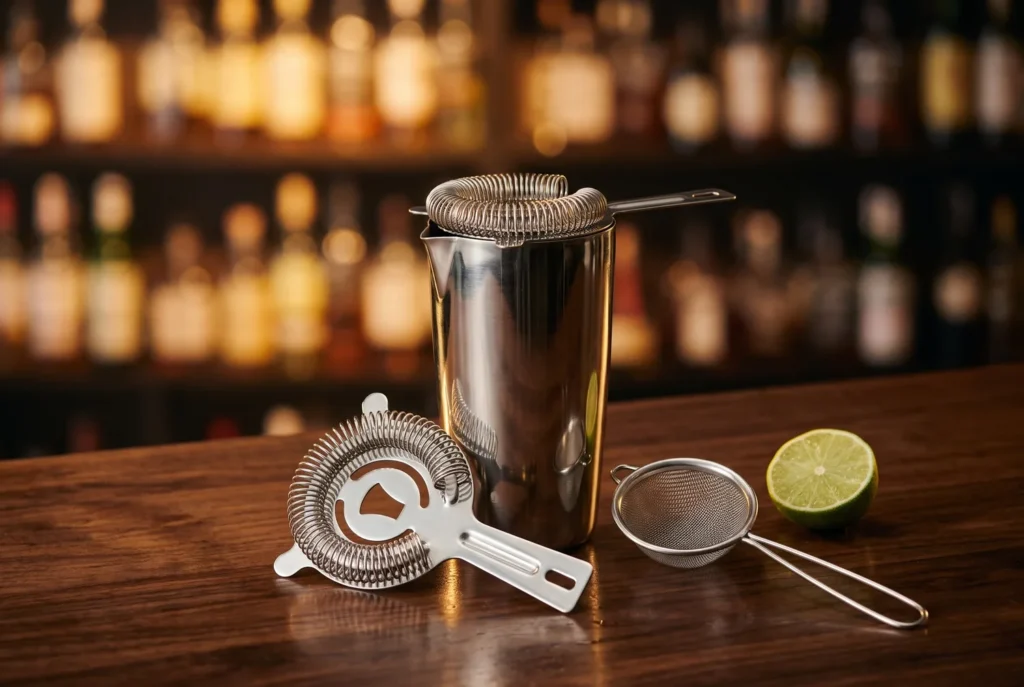
Recognisable by the coiled spring around its edge, the Hawthorne is the most widely used strainer in bars. Its perforated disc sits over the opening of the shaker tin, and the spring hugs the side to hold back the ice and much of the solid matter. Two or three lugs keep it in place, and a handle lets you hold it firmly.
Its main strength is the spring: by sliding the disc forward or back with your index finger, you adjust the gap between strainer and tin. With the disc pressed against the rim, straining is tight and lets very little debris through; with the disc pulled back, the cocktail flows faster and carries more foam, which some egg white recipes call for.
To start with, a stainless steel spring Hawthorne strainer is perfectly suitable. If you like tools with character, the wolf-head Hawthorne strainer and the skull Hawthorne strainer do the same job with a decorative finish. An article in this guide will cover how to use the Hawthorne and how to adjust the straining.
The julep strainer, the mixing glass’s ally
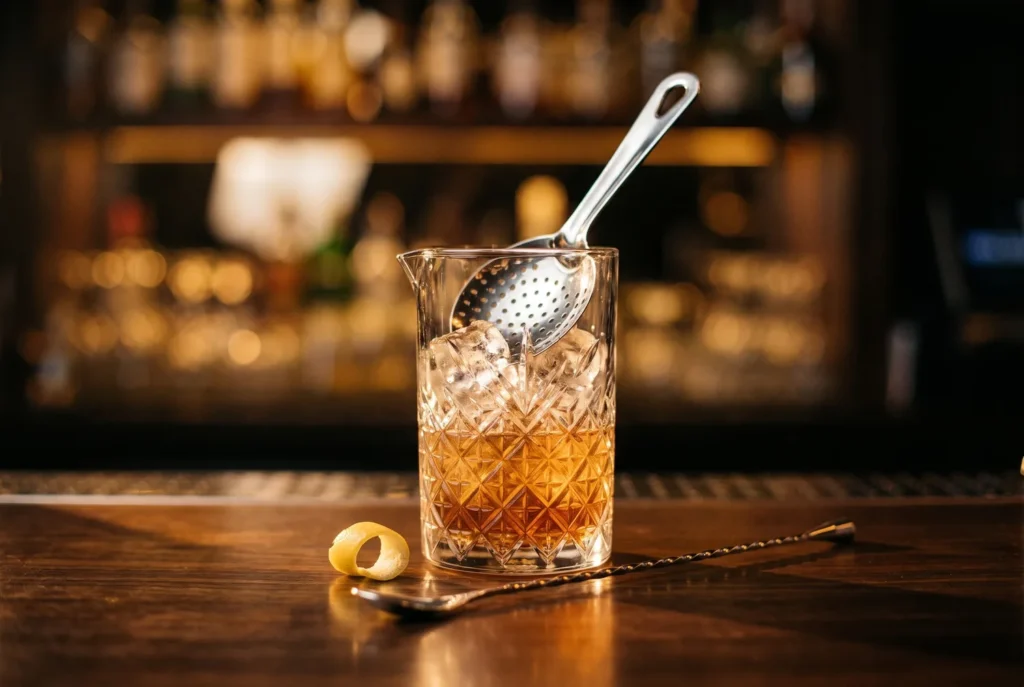
The julep strainer looks like a large, shallow spoon pierced with holes. It sits inside the mixing glass, domed side up, held against the ice with your fingertips while you pour. It takes its name from the Mint Julep: in the nineteenth century it was placed over the glass to hold back the crushed ice and mint while drinking, before straws became widespread.
Today it is used mainly for stirred cocktails such as the Manhattan or the Negroni. Its broad rim fits the round mouth of a mixing glass, where a Hawthorne, made for a tin, tends to tip over. As stirred cocktails contain no pulp or muddled herbs, its looser straining is no problem. The stainless steel julep strainer is the natural partner to a mixing glass: our guide to stirred cocktails shows how to use it as part of the full technique.
The fine strainer, for a perfect texture
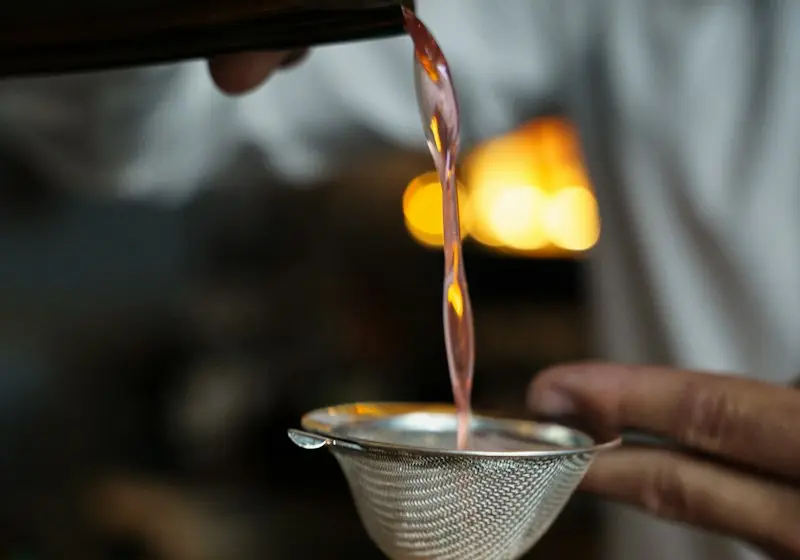
The fine strainer is a small conical sieve with a tight mesh and a handle. It is never used alone on a shaker: you hold it over the serving glass, below the Hawthorne, to catch whatever the first strainer let through, meaning ice shards, fine pulp, small pips and fragments of herbs.
A 5 cm tight-mesh fine strainer suits most glasses, and the pair of conical fine strainers lets you keep one clean while the other dries. For all-round use, the long-handled cocktail strainer stays comfortable above tall glasses.
When should you use a fine strainer?
- For shaken cocktails served without ice in a coupe, such as the Daiquiri or the Margarita, where ice shards would show on the surface.
- For recipes with fresh herbs or fruit muddled in the shaker.
- For homemade syrups, purées or infusions that may contain residue.
- For cocktails with a dense foam, to get a smooth, even surface.
A forthcoming article in this guide will go through every case where the fine strainer is essential, and those where it is unnecessary.
Double straining, step by step
Double straining means pouring the cocktail through the Hawthorne placed on the shaker, then through the fine strainer held above the glass. It takes both hands: one holds the shaker and the Hawthorne, the other the fine strainer, a few centimetres above the glass.
- Chill the serving glass and empty it just before straining.
- Open the shaker and set the Hawthorne on the tin holding the cocktail, index finger on the disc.
- Hold the fine strainer above the glass with your other hand.
- Pour with a confident movement through both strainers. If the fine strainer fills up, tap its handle lightly to help the liquid through.
- Finish with a small shake of the tin to catch the last drops.
The bartender’s tip
Do not let the cocktail sit in the fine strainer: it would warm up and lose its foam. Pour fairly quickly and tap the handle rather than stirring the sieve’s contents with a spoon, which would force the pulp through the mesh.
Our dedicated article on double straining explains the reasons for this technique and the recipes that benefit most.
Which strainer for which cocktail?
To find your way, here is a simple rule that covers the vast majority of recipes:
- Shaken cocktail served over ice: Hawthorne alone, over fresh ice in the glass.
- Shaken cocktail served without ice, in a coupe: Hawthorne and fine strainer, double straining.
- Stirred cocktail: julep strainer in the mixing glass, or a Hawthorne if it is the only one you have.
- Cocktail built in the glass, such as the Mojito: no strainer, since everything stays in the serving glass.
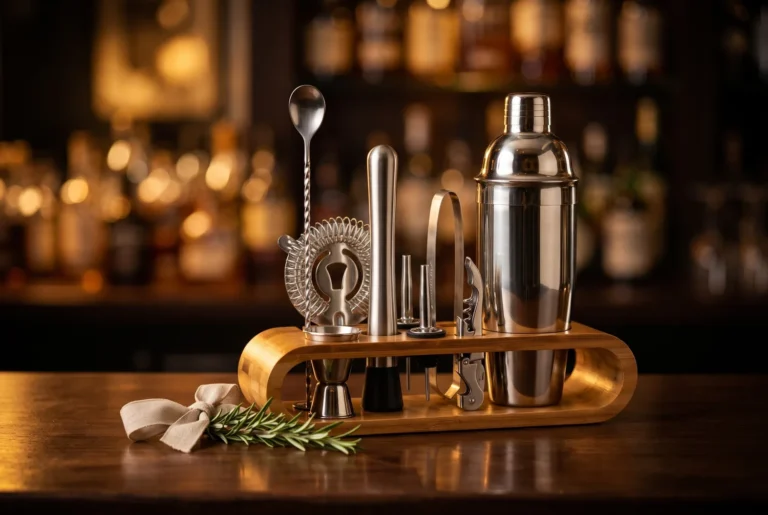
If you were to buy only one to begin with, choose the Hawthorne, the most versatile. Then add a fine strainer, inexpensive and essential for cocktails served in a coupe, and a julep the day you take up the mixing glass. You will find all three families in the strainers section, and they also come with most cocktail kits.
Choosing and caring for your strainers
Go for stainless steel, which does not rust or pass on any taste. On a Hawthorne, check that the spring is tight, with closely set coils: it is the spring that makes the straining fine. Make sure its diameter also suits your tins, especially if you use a Boston shaker. For a fine strainer, an even mesh and a rigid frame ensure a long life.
Rinse your strainers in clean water as soon as you finish: pulp and sugar that dry in the coils or the mesh are hard to remove. A soft brush helps clean the Hawthorne spring and the fine strainer’s mesh. Then dry them carefully, especially decorated or coloured models. To complete your kit, see our complete guide to the cocktail shaker and our guide to measuring cocktails with a jigger.
And for alcohol-free drinks?
Strainers are just as useful for alcohol-free cocktails, which are often rich in fresh fruit, herbs and homemade syrups: double straining gives a drink as clean and silky as a classic, with no pulp or ice shards.
Frequently asked questions
Which cocktail strainer should I buy first?
The Hawthorne: it fits the shaker, suits most recipes and can stand in on a mixing glass. Then add a fine strainer.
Can I use a kitchen sieve instead of a fine strainer?
Yes, if its mesh is fine and it is small enough to hold over a glass. A bar fine strainer remains easier to handle and more precise.
Why use a julep strainer rather than a Hawthorne with a mixing glass?
The julep fits the wide, round mouth of the mixing glass and is easy to hold against the ice, whereas the Hawthorne, designed for a tin, tends to slip.
Is double straining always necessary?
No. It is useful for shaken cocktails served without ice or containing herbs and fruit. For a cocktail served over ice or a stirred cocktail, one strainer is enough.
The articles in this guide

Fine strainer: when to use it for your cocktails, and when to leave it out
Muddled herbs, fruit, pulp, ice shards, homemade syrups: the cases where a fine strainer is essential, those where it adds nothing, and how to choose a…
The julep strainer: its history, how to use it with a mixing glass and the right technique
Where the julep strainer comes from, why it belongs with the mixing glass, how to hold it and strain a stirred cocktail, and how to choose…
How to use a Hawthorne strainer: from the spring to a tight or loose strain
How to hold a Hawthorne strainer, adjust the gap between the disc and the tin, strain tight or loose, pair it with a fine strainer and…

Double straining: why and how?
A Hawthorne strainer and a fine strainer used together: what double straining is for, and how to do it right with every shaken cocktail.

Please drink responsibly. Alcohol abuse is dangerous for your health.