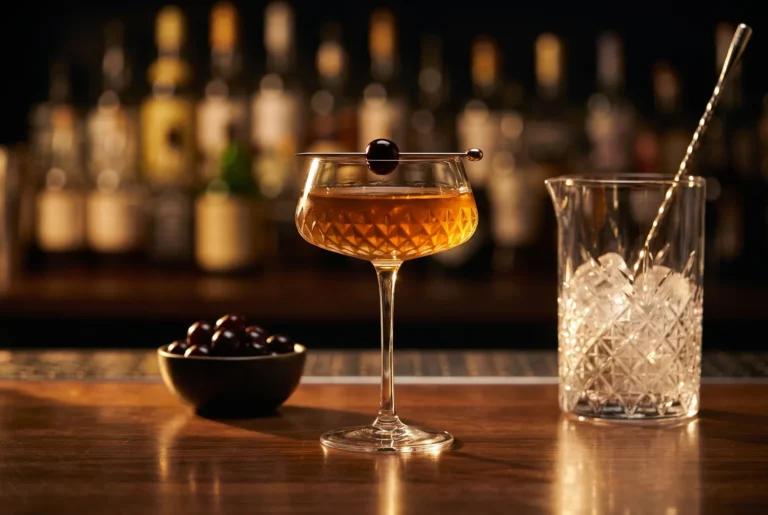
The mixing glass looks like the simplest tool on the bar: a large, heavy vessel with a pouring lip, nothing that jams or leaks. Yet it is what makes or breaks a Negroni, a Manhattan or a Dry Martini, those crystal-clear cocktails that are stirred rather than shaken. Used well, it gives a drink that is cold, silky and diluted just enough; used badly, it gives a cocktail that is lukewarm or watery. This article walks through every step, from preparing the glass to serving, with the reason behind each movement.
If this family of cocktails is new to you, start with our guide to stirred cocktails, which explains why some recipes are stirred and introduces all the equipment. Here, we focus on the method.
Before you start: the equipment and the ice
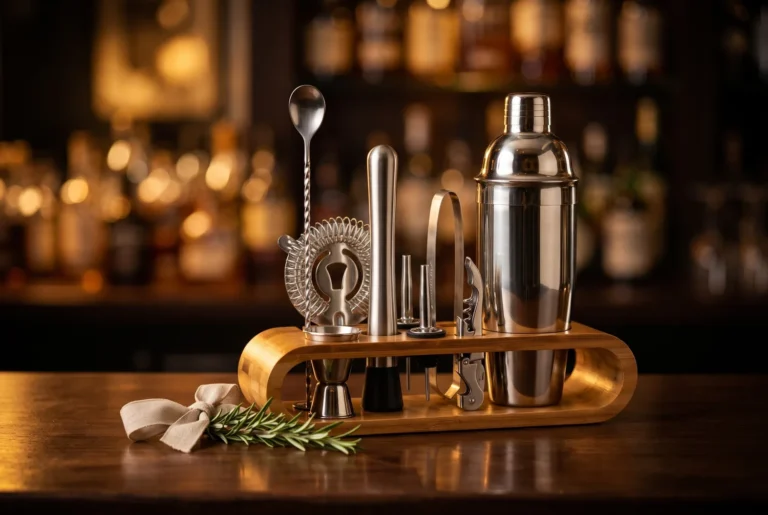
To use a mixing glass the way bartenders do, gather four tools before you open a single bottle:
- The mixing glass itself, 500 to 700 ml: wide enough for the ice and the spoon, heavy enough not to move. A 700 ml mixing glass with vertical ribs is right for one or two cocktails at a time.
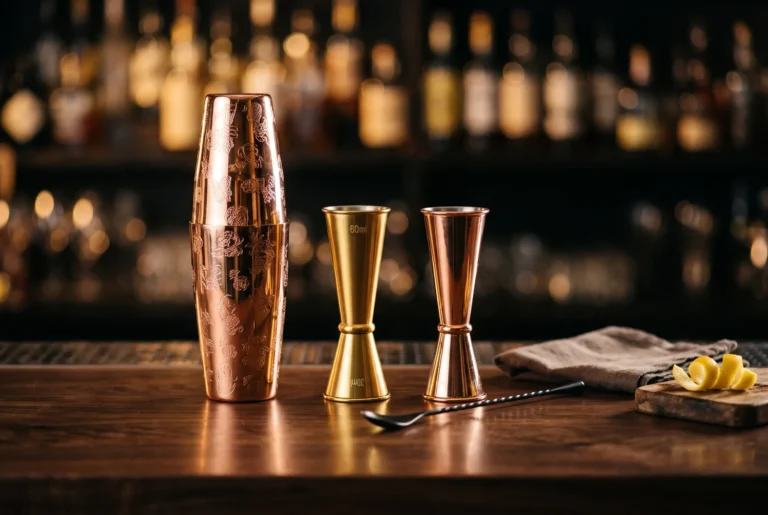
- A bar spoon about thirty centimetres long, which reaches the bottom without your fingers touching the ice, such as the 30 cm twisted bar spoon in a black finish.
- A julep strainer, which sits inside the glass to hold back the ice as you pour: the stainless steel julep strainer is made for exactly this.
- A jigger, because stirred cocktails, made almost entirely of spirits, are unforgiving of rough measuring. A graduated 30/60 ml Japanese jigger also lets you measure 15 or 20 ml.
The ice matters as much as the tools. Use solid, hard, dry cubes straight from the freezer. Ice that has started to melt is already wet: it dilutes too quickly and chills less. Small hollow cubes and crushed ice are best avoided for the same reason, as their large surface area waters the drink down in seconds. Our article on ice and garnishes covers the different kinds of ice and when to use them.
Step 1: chill the glasses
A stirred cocktail is usually served without ice, in a coupe or a stemmed glass. Anything that warms it after straining is lost. Put the serving glass in the freezer for about ten minutes, or fill it with ice and water while you make the drink, then empty it at the last moment.
Some bartenders chill the mixing glass too: they fill it with ice, stir for a few seconds, then pour away the meltwater before adding the ingredients. This helps with a thick glass kept at room temperature, which absorbs some of the cold; it is optional if you work quickly.
Step 2: pour the ingredients, then the ice
Pour the ingredients into the mixing glass before the ice. As long as there is no ice, nothing melts: you can take your time measuring, and correct yourself if you hesitate over a measure, without dilution starting. The order usually recommended runs from cheapest to most expensive and from smallest volume to largest:
- The bitters, in dashes.
- Syrups and liqueurs measured with the bar spoon or in small measures.
- Vermouths and other aromatised wines.
- The base spirit, last.
That way, if you make a mistake along the way, you only lose inexpensive ingredients. Then fill the glass two-thirds to three-quarters full with ice: the ice should sit above the level of the liquid. The more ice there is, the faster and more evenly the cocktail chills; a glass only half full of ice gives a drink that is less cold and more diluted, because the few cubes present melt more.
The bartender’s tip
Do not fill the mixing glass to the brim with ice: leave two or three centimetres below the rim. The spoon needs room to turn without the cubes spilling over, and the julep strainer needs to sit flat on the ice.
Step 3: stir
Slide the bar spoon down the side of the glass, back of the bowl against the glass, all the way to the bottom. Hold the shaft lightly with your fingertips, without gripping, and move the spoon around the inside wall: it is the ice that should turn as one block with the liquid, not the spoon that should whisk. A good stir is smooth and almost silent; repeated knocks against the glass crack and chip the ice, which speeds up dilution.
Allow 20 to 40 seconds in general, depending on the size and temperature of the ice. Rather than timing yourself, rely on three signs:
- The outside of the glass is very cold to the touch and fogs up, or even frosts lightly.
- The liquid level has risen by about a quarter: that is the meltwater joining the cocktail.
- The taste: take a few drops on the tip of the spoon. The alcohol should seem rounded, not hot, and the drink should not taste watery.
The exact way to hold the spoon and move your fingers will be covered in a dedicated article of this guide. To begin with, remember above all that a slow, steady movement beats a fast, jerky one.
Step 4: strain
Empty the ice and water from the serving glass. Place the julep strainer in the mixing glass, hollow side down, resting on the ice. Hold the mixing glass in one hand, index finger on the strainer handle to keep it in place, and pour through the lip in one continuous movement, without jerks. That is precisely what the pouring lip is for: the liquid comes out in a clean stream, without running down the side.
A sprung Hawthorne strainer also works if it is all you have, but it is designed first for the shaker and fits wide openings less well. Double straining through a fine strainer, on the other hand, is unnecessary for a stirred cocktail: it contains neither pulp nor ice chips. The differences between these tools are explained in our guide to cocktail strainers.
Step 5: serve straight away
A stirred cocktail is at its best within a minute of straining. Serve it immediately, then add the garnish the recipe calls for: a twist expressed over the glass to release its oils, an olive or a cherry. For recipes served over ice, such as the Negroni or the Old Fashioned, strain over a fresh large cube in a short glass, never over the ice from the mixing glass, which has already started to melt.
Other classics made this way include the Manhattan, the Dry Martini and the Martinez, served in an etched cocktail coupe. The same method works for clear alcohol-free drinks: a cold infusion, an aromatic syrup and a few dashes of non-alcoholic bitters, stirred over ice then strained, take on the same silky texture.
The most common mistakes
- Adding the ice first: dilution begins while you measure, and every hesitation costs you water.
- Using too little ice: the cocktail chills poorly and dilutes more.
- Stirring too little: the alcohol stays harsh and the drink is not cold enough.
- Stirring too long: the cocktail turns watery and loses its character.
- Leaving the cocktail sitting in the mixing glass: the ice keeps melting. Strain as soon as it is ready.
- Reusing the ice from one cocktail to the next: it is wet and carries the flavour of the previous recipe.
Looking after your mixing glass
Rinse the mixing glass and spoon in clean water between cocktails, especially after a vermouth or liqueur that would leave a taste behind. Wash them by hand in hot soapy water and dry them with a soft cloth. Avoid thermal shock: do not pour very hot water into a glass straight from the freezer, or ice into a glass still hot from washing. Finely cut glasses, such as the diamond-cut mixing glass, are best cleaned with a soft brush to reach the bottom of the pattern. If you prefer an unbreakable model, the mixing glasses range also includes a stainless steel one, and spoons are in the bar spoons range.
Frequently asked questions
How much ice should go in a mixing glass?
Fill it two-thirds to three-quarters full, so that the ice sits above the level of the liquid. The more plentiful and colder the ice, the faster the cocktail chills without over-diluting.
Should the ice go in before or after the ingredients?
After. By pouring the ingredients into the empty glass first, you measure without the ice starting to melt, then add the ice just before stirring.
Can I make two cocktails at once in a mixing glass?
Yes, in a 700 ml glass: double the measures, add a little more ice and stir a few seconds longer, tasting to check the dilution.
Can I use a mixing glass without a strainer?
You can hold back the ice with the back of the bar spoon, but the pour is less clean and ice chips get through. A julep strainer remains the simplest and tidiest solution.
Please drink responsibly. Alcohol abuse is dangerous for your health.