Layered cocktails are recognisable at first glance: clean bands of colour resting one on top of the other without mixing. The result looks spectacular, but it relies on a simple physical principle and a technique you can master in a few attempts. This guide explains why liquids settle in layers, in what order to pour them, how to use a bar spoon to lay them down gently, and which classic recipes lend themselves to it, from the B-52 to the pousse-café.
The principle: from heaviest to lightest
Two liquids form layers when they do not have the same density: the heavier one stays at the bottom and the lighter one floats on top. Behind the bar, two things change the density of an ingredient.
- Sugar makes it heavier: syrups, grenadine, fruit crèmes and very sweet liqueurs sink to the bottom of the glass.
- Alcohol makes it lighter: the stronger and drier a spirit, the lighter it is. Rum, whisky or cognac therefore sit happily as the top layer.
- Cream and cream liqueurs often fall between the two, which makes them good middle layers.
The practical rule is therefore: start with the sweetest, least alcoholic ingredient and finish with the driest and strongest. Two ingredients of similar density will always blend a little: the bigger the gap, the sharper the line between layers. Sugar content varies from one brand to another; if you change bottles, run a test before serving.
The technique: pouring over the back of a bar spoon
The secret of a clean layer is to break the fall of the liquid so that it settles instead of plunging. It is one of the classic uses of the bar spoon, alongside stirring, which is covered in our guide to stirring a cocktail with a bar spoon.
- Pour the first layer straight into the bottom of the glass without splashing the sides.
- Turn the bar spoon over, rounded side up, and rest its tip against the inside of the glass, just above the first layer.
- Pour the second layer very slowly over the back of the spoon: the liquid runs down the side of the glass and spreads across the surface.
- Raise the spoon as the level rises, so that it always stays just above the liquid.
- Repeat for each layer, rinsing and wiping the spoon between ingredients.
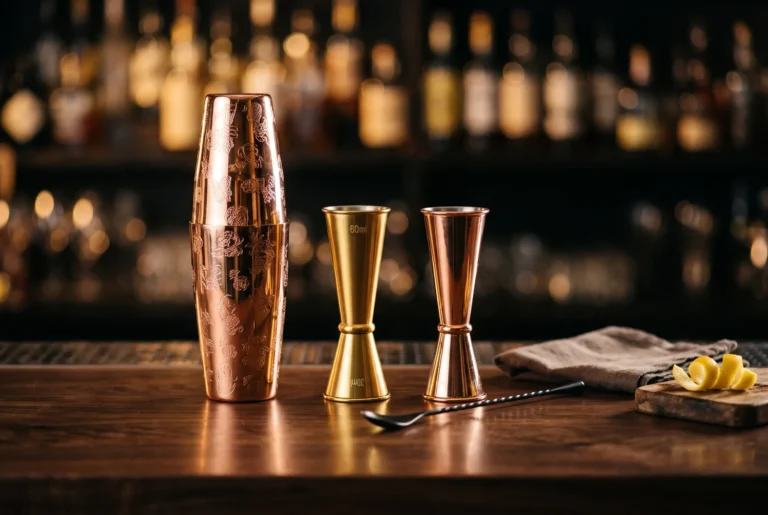
A 30 cm twisted bar spoon is well suited: its long handle keeps your hand away from the glass, and its twist helps guide the stream when you pour down the handle. A set of 3 twisted spoons saves rinsing between layers. For such small volumes, a graduated Japanese jigger is invaluable: its inner markings let you measure 10 or 20 ml accurately, and its narrow lip pours a steady stream.
The bartender’s tip
Pour from the jigger rather than the bottle: the flow is slower and easier to control. Well-chilled ingredients also layer more easily, because they mix more slowly.
Choosing the glass
A narrow, straight-sided glass gives the best layers: the surface of each liquid is small, less volume is needed to form a visible band, and the line stays level. That is why layered drinks are most often served in a small straight glass, a shot glass or a slim flute. In a flared glass or a coupe, the layers would be very thin and harder to lay down. Our guide which glass for which cocktail presents the main shapes.
Two classic examples: the B-52 and the pousse-café
The B-52
The B-52 is the best-known layered drink: three equal thirds, served in a small straight glass. You pour the coffee liqueur first, as it is the sweetest, then the Irish cream liqueur, and finally a cognac-based orange liqueur on top. The three layers, dark brown, ivory and amber, should stay clearly separate. It is a good one to practise with, as the differences in density are pronounced.
The pousse-café
The pousse-café is an older family, already found in 19th-century bar manuals: several liqueurs and spirits of different colours are layered, sometimes five or six, in a narrow glass. There is no single recipe; the principle is always the same, from sweetest to driest. It is the ultimate test of skill, calling for patience and strongly contrasting ingredients.
Common mistakes
- Pouring too fast: the liquid breaks through the layer below and everything turns cloudy. A thin, steady stream is enough.
- Getting the order wrong: a sweet liqueur poured onto a dry spirit sinks straight through to the bottom. Check the order before you start.
- Moving the glass: build the drink where it will be served, or move it very gently.
- Holding the spoon too high: if the spoon is far from the surface, the liquid drops instead of sliding. Keep it just touching the level.
The same technique is used to float a final touch on a shaken or stirred cocktail, such as a dash of spirit laid on the surface of a long drink. To know when to shake and when to stir the base, see our article shaker or mixing glass, and for the whole technique, our guide to stirred cocktails. Our spoons are gathered in the bar spoons section.
Layers work without alcohol too: grenadine syrup at the bottom, orange juice in the middle and lemonade poured gently over the back of the spoon make a colourful gradient that children love.
Frequently asked questions
Why do my layers mix?
Most often, the pour is too fast or the spoon is held too high. Two ingredients may also be too close in density: change the order or replace one with a sweeter or drier ingredient.
Which ingredient goes in first?
The sweetest and least alcoholic: syrup, grenadine, fruit crème or a very sweet liqueur. The strongest, driest spirit goes in last.
Do you need a special spoon for layering?
No, a long bar spoon is enough: pour over its back with the tip resting against the side of the glass. Some spoons have a flat disc at the end of the handle, which is handy for the same purpose.
Can you make a layered cocktail in advance?
It is best served straight away: over time and with movement, the layers gradually bleed into one another.
Further reading
Please drink responsibly. Alcohol abuse is dangerous for your health.