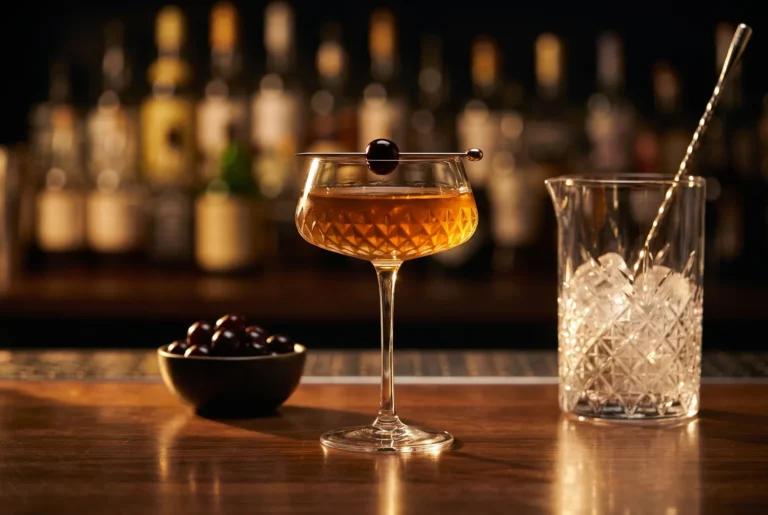
A Negroni, a Manhattan or a Dry Martini is never shaken: it is stirred. A stirred cocktail is made in a mixing glass full of ice with a long bar spoon, then strained into a chilled glass. The result is crystal clear, silky and thoroughly cold, with no air bubbles or ice shards. In this guide you will learn why some cocktails are stirred rather than shaken, which tools to choose, how to stir step by step and which great classics await once you have mastered the technique.
Stirring or shaking: what changes in the glass
Shaking and stirring share the same aim: to chill the ingredients, combine them and add just the right amount of meltwater, which softens the alcohol and ties the flavours together. The difference lies in how you get there and in the texture you end up with.
In a shaker, the ice crashes violently into the liquid. It chills it very quickly, aerates it and leaves it slightly cloudy and frothy. That is ideal for recipes containing citrus juice, thick syrups, cream or egg white, which need energy to emulsify. In a mixing glass, the ice turns gently with the liquid. Chilling is a little slower, dilution more gradual and easier to control, and no air is beaten in. The cocktail stays clear and dense on the palate, with an almost oily texture.
Hence the simple rule most bartenders follow:
- Stir cocktails made only of spirits, vermouths, liqueurs, bitters and light syrups: they are clear and should stay that way.
- Shake cocktails containing fruit juice, dairy, eggs or purées: they need to be emulsified.
- There are exceptions: some cocktails with very little juice are sometimes stirred, and a few bartenders deliberately shake classically stirred drinks for a different texture. The rule is still an excellent starting point.
If you already make shaken cocktails, our complete guide to the cocktail shaker will help you compare the two techniques. An article in this guide will look in detail at the question of shaker or mixing glass, with plenty of recipe examples.
The tools for a stirred cocktail
Three tools are enough to stir like a bartender, plus the measure you already use for your other recipes.
The mixing glass
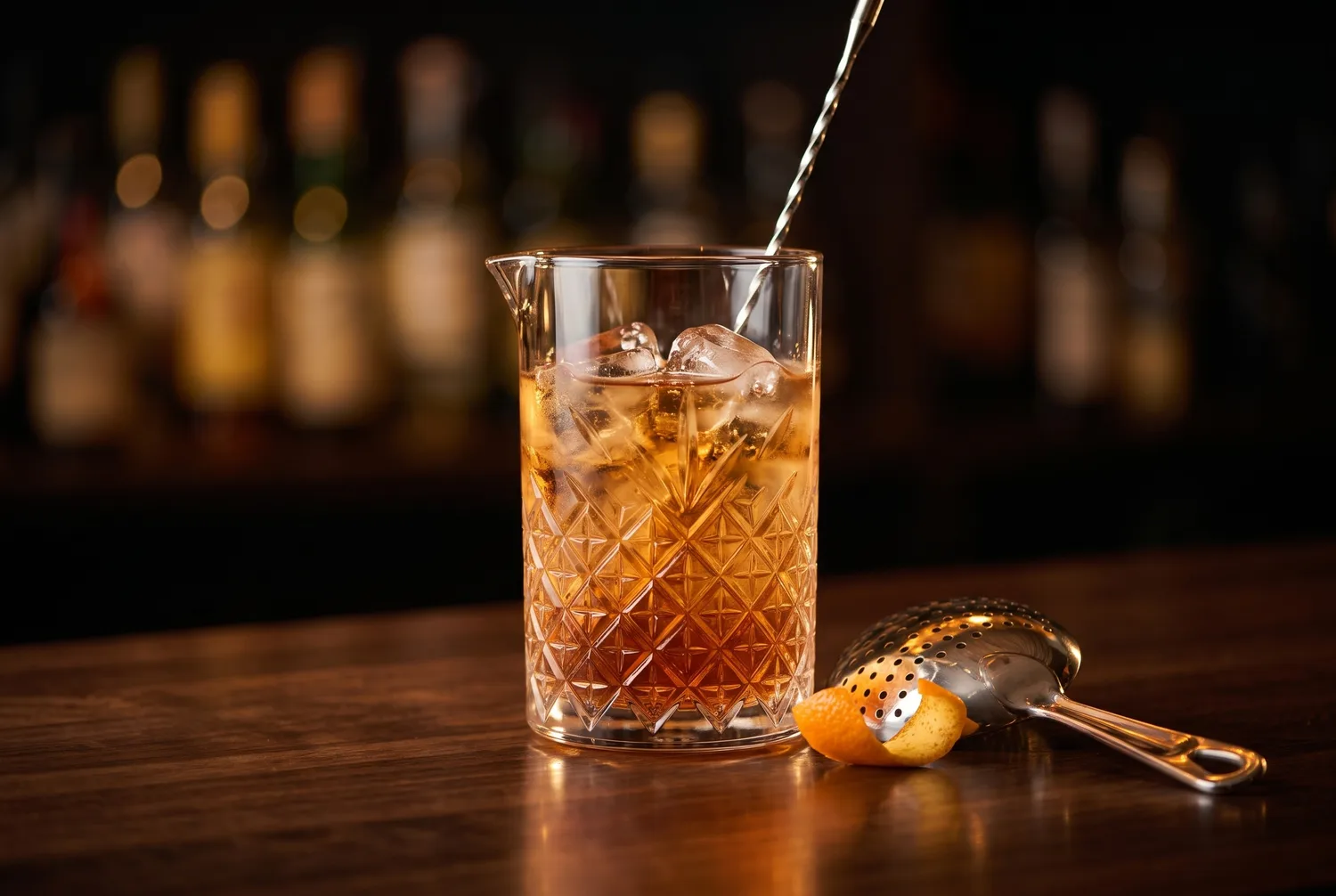
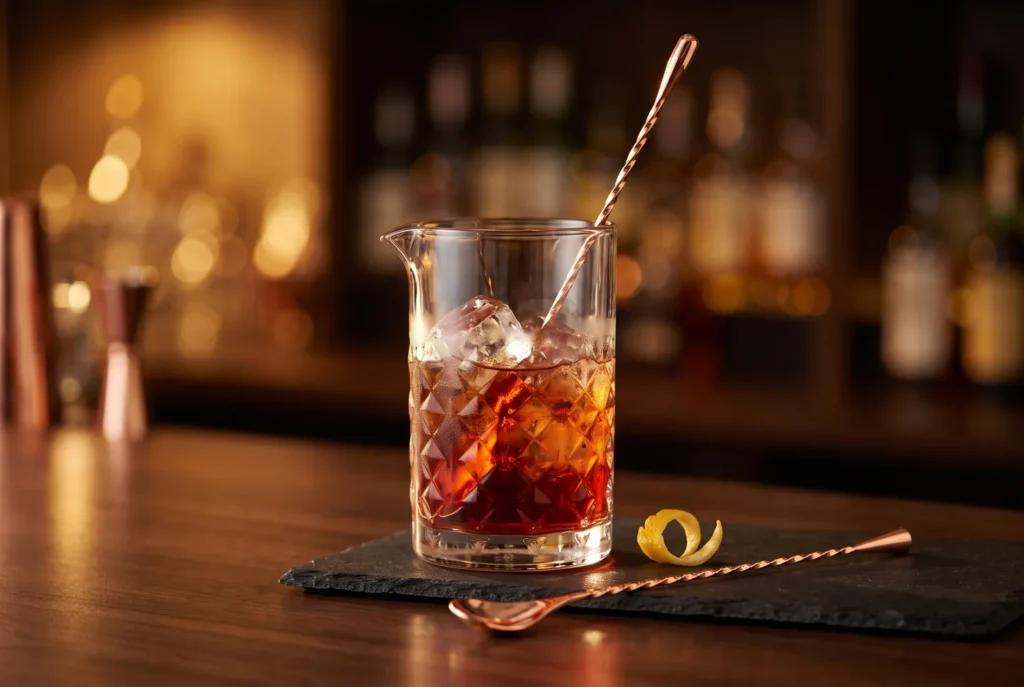
This is a wide, stable vessel with a thick base and a pouring lip. Its width leaves room for the spoon and plenty of ice, its weight keeps it still while you stir, and its lip lets you pour cleanly. A capacity of 500 to 700 ml is right for one or two cocktails at a time.
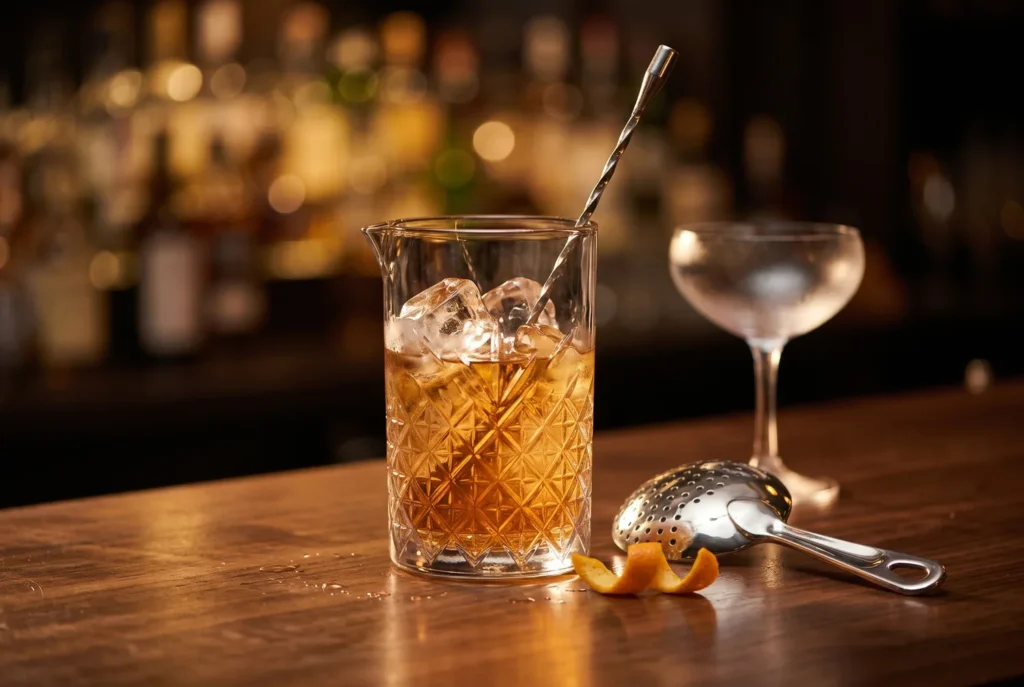
Thick glass models are the most common and let you watch the ice turn, which helps you refine your technique. The 700 ml crystal-cut mixing glass and the 700 ml diamond-point mixing glass combine a heavy base with a cut pattern that gives a good grip. The vertical-ribbed model has a plainer line. If you worry about breakages, the 550 ml diamond-pattern stainless steel mixing glass is unbreakable and holds the cold very well. All our models are in the mixing glasses section.
The bar spoon
Around thirty centimetres long, the bar spoon reaches the bottom of the mixing glass without your fingers touching the ice. Its twisted handle spins easily between the fingers for a smooth, quiet movement; it also lets you run a liquid down the spiral to build layers. The small bowl holds roughly 5 ml of a syrup or liqueur.
To start with, a 30 cm twisted bar spoon in a silver finish is perfectly suitable. The black and rose gold finishes match the other tools on your bar, and the set of 3 twisted bar spoons lets you keep one for each use. Find them in the bar spoons section.
The julep strainer and the jigger
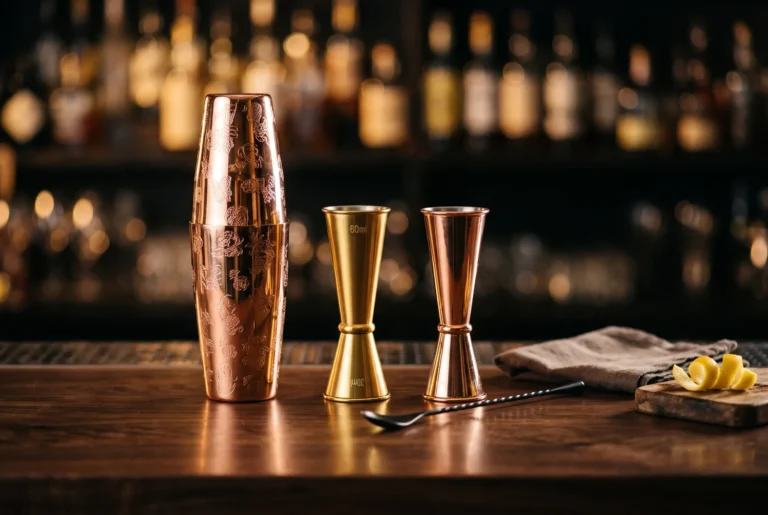
The julep strainer, shaped like a large perforated spoon, sits inside the mixing glass to hold back the ice as you pour. It is made for this job, better suited than the Hawthorne strainer, which was designed mainly for the shaker. A stainless steel julep strainer is therefore the natural partner to a mixing glass. Finally, stirred cocktails rely on precise proportions: a graduated 30/60 ml Japanese jigger will help you respect them, as explained in our guide to measuring cocktails with a jigger.
The technique step by step
Stirring a cocktail is not complicated, but every step matters. Here is a method you can apply to every stirred recipe.
- Chill the serving glass: put it in the freezer, or fill it with ice and water while you work. A stirred cocktail is served without ice in a coupe, or over a large cube in a rocks glass.
- Pour the ingredients first into the empty mixing glass, measuring them with the jigger. That way dilution does not start before you are ready.
- Add the ice to three quarters full, or even to the brim. Cold, dry ice in large cubes melts more slowly and dilutes more evenly than wet or cracked ice.
- Stir: slide the spoon down the side, the back of the bowl against the glass, and turn it in a steady circle. The ice should turn as one block with the liquid, without clinking.
- Taste after about twenty seconds with a straw or the tip of the spoon: the cocktail should be very cold, its strength softened but still present. Carry on if needed.
- Strain through the julep strainer into the drained serving glass, then add the garnish: a citrus twist expressed over the glass, a cherry or an olive, depending on the recipe.
The bartender’s tip
Allow 20 to 40 seconds of stirring on average, depending on the size and temperature of your ice. Rather than timing it, trust your taste and touch: when the outside of the mixing glass is very cold and lightly frosted, you are close. Ice straight from the freezer dilutes more slowly than ice that has sat in a bucket for a while.
The spoon technique, how to hold it between your fingers and the rhythm to adopt will be the subject of a dedicated article in this guide, as will the detailed use of the mixing glass, from the ice to serving.
The great stirred cocktails to know
The stirred family includes some of the most famous recipes in the repertoire. They all rest on a balance between a spirit, an aromatic element such as vermouth or a liqueur, and often a few dashes of bitters.
- The Negroni: gin, red vermouth and bitter liqueur in equal parts, balancing bitterness and sweetness. See our Negroni recipe.
- The Old Fashioned: whisky, sugar, bitters and orange zest, served over a large cube. See our Old Fashioned recipe made in the mixing glass.
- The Manhattan: rye whiskey or bourbon, red vermouth and bitters, served in a coupe with a cherry.
- The Dry Martini: gin and dry vermouth, served ice cold with a lemon twist or an olive.
- The Boulevardier, the Sazerac or the Vieux Carré: lesser-known classics, ideal for taking the technique further.
To serve them, an engraved cocktail coupe suits recipes served without ice, while light whisky glasses take those served over a cube.
And without alcohol?
The technique works just as well for clear alcohol-free drinks: a mix of cold infusion, aromatic syrup and alcohol-free bitters, stirred over ice and strained into a coupe, gains the same silky texture and the same freshness as a classic. It is a lovely way to offer a carefully made drink to guests who do not drink alcohol.
The topics in this guide
This guide is completed by several articles that look more closely at each aspect of the stirred cocktail. The first explains how to use a mixing glass: how much ice, the order of the ingredients, when to strain and how to serve. A second focuses on the bar spoon technique: the grip, the circular movement and the timing.
A third article settles the question of shaker or mixing glass using the cloudy-ingredient rule and its exceptions. A fourth explains how to layer a cocktail using the twisted spoon and the densities of liqueurs. Finally, a last article helps you choose your mixing glass by capacity, thickness, pouring lip and material, glass or stainless steel.
Looking after your tools
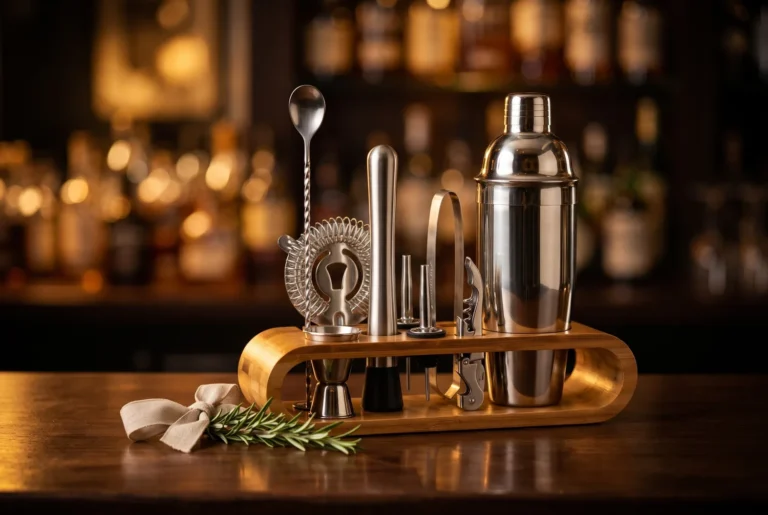
Rinse the mixing glass and spoon with clean water between cocktails, especially after a vermouth or a sweet liqueur that would linger in the next recipe. Wash the glass by hand in hot soapy water and avoid thermal shocks: never pour boiling water into a glass straight from the freezer. Dry the spoon at once with a soft cloth, particularly coloured finishes, so they keep their shine. To complete your workstation, see our selection of the essential tools for a home bar.
Frequently asked questions
How long should you stir a cocktail?
Usually between 20 and 40 seconds, depending on the ice. The most reliable test is to taste: the cocktail should be very cold and its alcohol softened, without tasting watery.
Can you stir a cocktail without a mixing glass?
Yes, in the large tin of a Boston shaker or in a large thick glass, with a strainer to pour. A mixing glass remains more stable and more pleasant to use thanks to its pouring lip.
Why is a stirred cocktail clear?
Because the ice turns with the liquid without striking it: no air bubbles or ice shards are incorporated, unlike in a shaker.
Which bar spoon should a beginner choose?
A stainless steel twisted spoon about 30 cm long: long enough to reach the bottom of the mixing glass, it spins easily between the fingers and can also be used to build layers.
The articles in this guide

How to choose a mixing glass: glass or stainless steel, capacity and the details that matter
Cut glass or unbreakable stainless steel, 550 or 700 ml, pouring spout, weighted base, thick walls: the practical criteria for choosing a mixing glass that suits…
Layered cocktails: how to float liqueurs without mixing them
How to make layered cocktails with clean bands: how sugar and alcohol affect density, pouring over a bar spoon, the order of ingredients, and the B-52…
Shaker or mixing glass: when to stir and when to shake a cocktail
Shake or stir? The simple rule of cloudy and clear ingredients, what each technique changes in the drink, the known exceptions and classic recipes sorted by…
Stirring a cocktail with a bar spoon: the grip, the movement and the timing
Hold the bar spoon with your fingertips, turn the ice in silence, know when to stop: a step-by-step method for stirring a cocktail smoothly and consistently.
How to use a mixing glass: ice, measuring, stirring, straining and serving
Chill, measure, fill with ice, stir, then strain: a step-by-step method for using a mixing glass to make stirred cocktails that are clear, cold and properly…


Please drink responsibly. Alcohol abuse is dangerous for your health.