Owning the right tools is not enough: you also need to find them the moment you need them. To organise your home bar is to arrange equipment, ice, bottles and glasses so that you can move from one step to the next without searching, without spilling and without taking over the whole kitchen. This guide sets out a simple method that works for a corner of worktop as well as for a proper bar cabinet: define a workstation, store tools by use, plan a place for ice and garnishes, then organise bottles and glasses. You will also find the habits that keep everything tidy from one evening to the next.
It follows on from our guide to equipping your home bar: once the equipment is chosen, it needs a place. If you have not sorted your kit yet, start with the list of essential tools for a home bar.
The workstation: a dedicated, stable surface
Everything starts with a fixed area where you make your cocktails. Choose a spot at waist height, close to a sink if possible, and wide enough for a shaker, two glasses and a chopping board. There is no need to overdo it: around sixty centimetres of clear worktop is enough for most cocktails at home.
On this area, a non-slip bar mat makes daily life easier. It catches drips and splashes, stops the mixing glass or shaker from sliding, and marks out visually where you work. A second mat laid alongside is useful for draining rinsed tools during the evening. For a touch of colour, the red bar mat does the same job.
- In front of you: the mat, where you build and pour.
- On your right (or left if you are left-handed): the tools your dominant hand reaches for most often.
- Behind: the bottles for the evening, labels facing you.
- On the other side: ice and garnishes, within reach of your free hand.
Storing tools by use
Good storage follows the order of your movements. The tools you use for every cocktail stay on the workstation; those you use now and then go into a drawer or a box close by.
The tools for every cocktail
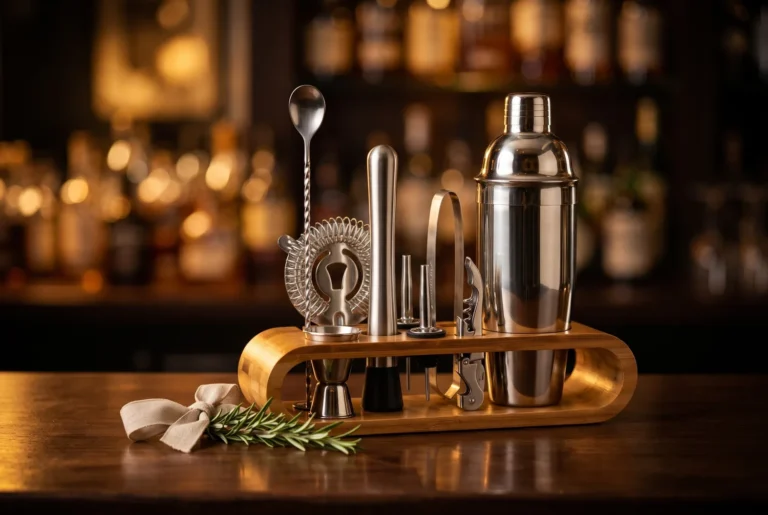
The shaker, jigger, bar spoon and strainer form the core. Store them upright, in a pot or on a stand, rather than flat in a drawer: you see them at a glance and they dry better. Kits with a stand solve the question in one go, such as the 22-piece cocktail kit on a two-tier stand or the cocktail kit on a bamboo stand, where each piece has its own slot.
The occasional tools
Muddler, citrus squeezer, paring knife, peeler for twists, stainless steel garnish tweezers: these tools only come in at certain steps. A box or a tray beside the workstation is enough, as long as you put them back in the same place each time. It is this consistency that saves time, far more than the amount of equipment you own.
The bartender’s tip
Before an evening starts, run through the first planned recipe in your head while touching each tool you will need. Anything missing or badly placed shows up straight away, before your guests are left waiting.
Ice and garnishes: prepare before you serve
Ice quickly takes up all the space unless you set some aside for it. For an evening, plan a bucket or a large bowl, placed on a tea towel to absorb condensation, and serve with a stainless steel ice scoop rather than with the glass or your fingers: it is cleaner and you do not risk breaking a glass in the ice. Keep the rest in the freezer and top up as the evening goes on. The role of each type of ice is explained in our guide to ice and garnishes.
Garnishes are prepared before your guests arrive: citrus washed, wedges and twists cut, fresh herbs standing in a glass of water, all set out in small bowls near the ice. Cover them and keep them cool if there is a long wait, because a twist cut too early loses some of its oils.
Bottles: what stays on the workstation and what is put away
Not all your bottles need to be on the worktop. Sort them into three groups:
- Bottles for the evening: those for the two or three cocktails you have planned, lined up behind the workstation. Fitted with stainless steel pourers, they pour one-handed into the jigger, with a steady stream and fewer drips on the neck.
- Reserve bottles: spirits and liqueurs used less often, stored away from light and heat, in a cupboard or closed cabinet.
- What goes in the fridge: opened vermouths, homemade syrups, squeezed juices, soda water and soft drinks. Vermouth is an aromatised wine: once opened, it keeps in the fridge and is best used within the following weeks.
To work out how many you need before a party, use our method for calculating how many bottles for a cocktail party.
Glasses: store them near the workstation and keep them clean
Cocktail glasses are stored upright, away from dust, ideally in a cabinet close to the workstation. Group them by shape: short glasses, tall glasses, coupes. On the night of a party, take out the number of glasses you need in advance and put a few coupes in the freezer about fifteen minutes before serving cocktails without ice, such as a Martini or a Daiquiri. To know which glass suits which drink, see our guide to which glass for which cocktail.
If space is short, a few versatile shapes are better than a mismatched collection: a short glass, a tall glass and a coupe cover most recipes.
During and after: the habits that keep the bar in order
A well-organised bar stays in order because you tidy as you go. Rinse the shaker, jigger and spoon under clean water between two cocktails, especially after citrus, milk or egg white, then lay them on the draining mat. Wipe splashes off the mat rather than letting them dry. A bartender’s apron protects your clothes and lets you keep a clean cloth at your waist.
At the end of the evening, wash and dry all the tools before putting them back in their place, close the bottles, put away in the fridge what belongs there and rinse the mats. The next day, the bar is ready to use again. Finally, think of guests who do not drink alcohol or who are driving: keeping a bottle of juice, soda water or a homemade syrup on the workstation lets you make them a carefully prepared drink with the same movements.
You will find mats, pourers, scoops and tweezers in our bar accessories range, and complete sets with stands among our cocktail kits.
Where should you set up a home bar?
On a stable surface at waist height, ideally close to a sink for rinsing tools. A corner of kitchen worktop or a low cabinet is enough, as long as you can fit a bar mat, a shaker and two glasses on it.
What is a bar mat for?
It catches drips and splashes, stops the shaker and glasses from sliding and serves as a draining area for rinsed tools. It also clearly marks out the spot where you make your cocktails.
Should every bottle have a pourer?
No: only the ones you use during the evening. Bottles kept in reserve keep their original cap or cork, which seals them better for long storage.
How should you store bar tools?
Upright and by use: the tools for every cocktail (shaker, jigger, spoon, strainer) on the workstation or on a stand, the occasional tools in a box next to it. Always put each tool back in the same place, clean and dry.
Further reading
Please drink responsibly. Alcohol abuse is dangerous for your health.