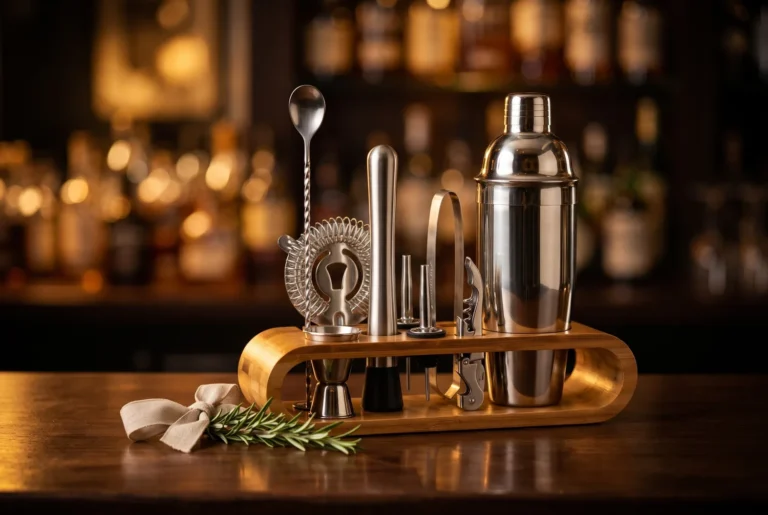
You have just shaken a cocktail, the shaker is frosted over, and it simply will not open: the two tins seem welded together, or the cap refuses to turn. A stuck cocktail shaker is one of the most common small annoyances behind a bar, at home and in professional bars alike. The good news is that it is almost never a fault in the shaker, but a simple physical effect. This guide explains why a shaker jams, then walks you through the moves to open it without forcing, on a Boston shaker as well as a Cobbler, and how to stop it happening again. It complements our complete guide to the cocktail shaker.
Why a shaker gets stuck
Two causes almost always work together. The first is cold. Metal contracts slightly as it cools. While you shake, the ice brings the temperature of the stainless steel down very quickly. On a Boston shaker, the small tin, pushed into the large one, cools in direct contact with the ice, just like the large tin; the two pieces tighten onto each other. On a Cobbler, the cap and built-in strainer, fitted onto the tin, contract too and grip their seat.
The second cause is a drop in pressure. When you close the shaker, you trap air at room temperature. As it cools against the ice, that air contracts and its pressure falls: the air outside then pushes the two pieces together, like a suction cup. The harder the shaker is closed and the colder it gets, the stronger the effect. It is the very same effect that keeps a Boston shaker sealed while you shake: it is useful, as long as it does not become excessive.
The bartender’s tip
Never slide a knife blade between the two pieces to lever them apart: you risk cutting yourself and bending the rim of the tin, which will never seal properly again.
Opening a stuck Boston shaker
On a tin-on-tin Boston shaker, the small tin does not sit perfectly straight in the large one: it is slightly tilted. On one side, the two walls touch; on the other, a small crescent-shaped gap separates them. The whole secret to opening it is to strike in the right place. The technique is covered in our guide on how to use a Boston shaker; here is the version for a shaker that is properly stuck.
- Stand the shaker on the counter, large tin at the bottom, and hold it firmly with one hand.
- Find the side where the two tins touch, in other words the side towards which the small tin leans.
- With the heel of your other hand, give a sharp tap to the top of the large tin, right at the join, on the side where the two walls touch. The knock very slightly flexes the round rim of the large tin and lets air in.
- If nothing moves, turn the shaker a little and try again a little further round the rim, without hitting any harder.
- As soon as you hear the air rush in, remove the small tin by tipping it towards you.
If the tap is not enough, leave the shaker for ten seconds or so: the trapped air warms slightly and the pressure difference eases. You can also squeeze the large tin just below the join between your thumb and fingers, to push it slightly out of round. A Boston shaker with a good, thick large tin, such as the engraved Boston shaker with lavender pattern, copes easily with these repeated small knocks.
Boston shakers with a glass
If your Boston shaker pairs a metal tin with a glass, never strike the glass. Hold the shaker by the tin, glass on top, and tap the rim of the tin where the glass touches it. Glass contracts far less than stainless steel, which explains why some mixed Boston shakers jam less, but also why a misplaced knock can chip it. To replace a fragile glass, a second metal tin, such as the 475 ml stainless steel shaker tin, turns your Boston into an all-steel model.
Opening a Cobbler with a jammed cap
On a Cobbler, two joins can stick: the small cap that covers the strainer, and the built-in strainer itself, fitted onto the tin. The small cap jams most often, because it is very thin and cools first. Our Cobbler shaker user guide covers how to assemble the three pieces correctly.
- Warm the join: wrap both hands around the top of the shaker for fifteen to twenty seconds. The warmth of your palms is often enough to expand the metal of the outer piece.
- Twist rather than pull: hold the tin in one hand and rotate the strainer, or the cap, one way then the other, as if unscrewing a jar lid. A twisting motion frees the piece more easily than a straight pull.
- Improve your grip: a dry tea towel or a non-slip bar mat placed over the cap stops your fingers sliding on the frosted metal.
- A little lukewarm water: as a last resort, run lukewarm water over the join alone for a few seconds, keeping the shaker upright. The cocktail is about to be strained: do not overdo it, or you will warm it.
A small tap with the heel of your hand on the side of the cap can also free it, just as on a Boston. Strike the side, never the top: a downward knock only pushes the piece further onto its seat. Well-fitted models, such as the 550 ml stainless steel Cobbler shaker, jam no more than any other, provided you do not force them shut.
Stopping a shaker from getting stuck
A few habits greatly reduce the risk. They all come down to limiting the cold at the join and the drop in pressure inside.
- Close without crushing: on a Boston, a light tap is enough to seal the two tins; there is no need to ram them together with all your strength. On a Cobbler, place the cap and press it down firmly, without screwing it.
- Keep the join dry: wipe the rims of the tins before closing. A film of sugar or syrup acts like glue once it is cold.
- Do not overfill: a shaker filled to the brim with ice and liquid suffers a stronger pressure drop. Leave room for the ice to move, as explained in our guide on which shaker size to choose.
- Open straight away: a shaker left closed on the counter for several minutes keeps cooling and grips even tighter. Strain as soon as you finish shaking.
- Shake for the right time: beyond fifteen to twenty seconds, you gain little extra chill and the shaker jams more. Our article on how long to shake a cocktail gives the right timings.
Your choice of equipment matters too. An all-steel Boston opens with a sharp tap once you have the knack, which is why every bar uses one; a Cobbler remains simpler for beginners but needs a little patience when it is very cold. If you are unsure, our comparison Boston or Cobbler: which shaker to choose will help you decide. The 3-piece Boston shaker set brings together both tins and a strainer to get started, and every model is in our Boston shakers range.
When the shaker itself is the problem
If your shaker jams every time, even when lightly filled and opened at once, check the condition of the rims. A tin that has been dropped on the floor can keep a slight dent or an out-of-round rim: the two pieces no longer fit together evenly and always stick in the same place. On a Cobbler, a bent cap will not regain its shape. In that case, the only lasting fix is to replace the damaged piece, for example with a separate tin for a Boston. Wash the joins carefully too: dried sugar residue eventually makes a cap seize.
Why does my shaker get stuck after shaking?
The cold makes the metal and the trapped air contract, creating a slight drop in pressure. The two pieces then grip each other, like a suction cup.
Where should you tap to open a Boston shaker?
On the rim of the large tin, at the join, on the side where the two pieces touch. A sharp tap with the heel of your hand is usually enough.
How do you open a jammed Cobbler shaker cap?
Warm the join between your hands, then twist the cap rather than pulling it. A dry tea towel improves your grip; a few seconds of lukewarm water as a last resort.
Can you use a knife to open a stuck shaker?
No. The blade can slip and cut you, and it bends the rim of the tin, which will no longer seal properly.
Further reading
Please drink responsibly. Alcohol abuse is dangerous for your health.